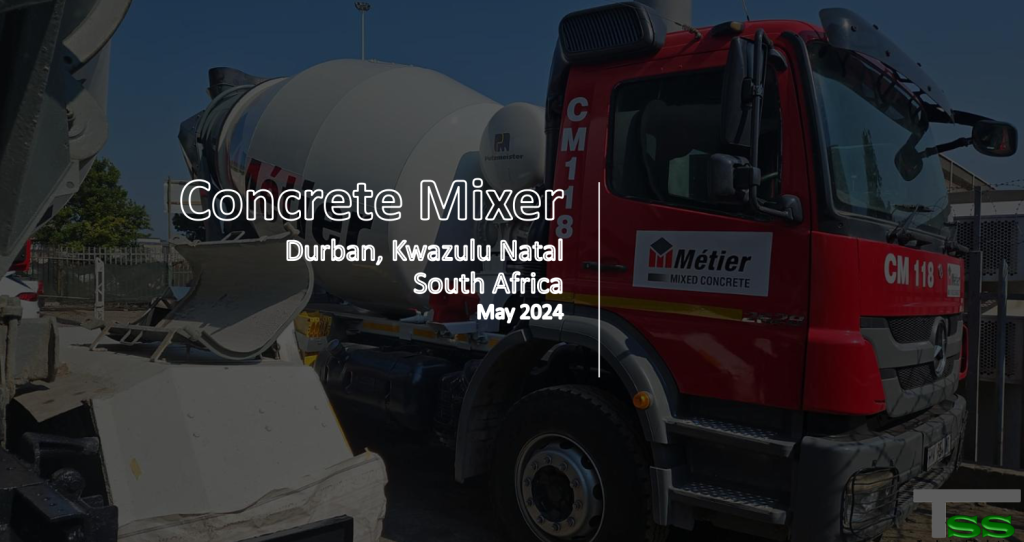
Cement Buildup Prevention on Concrete Mixer Trucks: A Real-World Trial in Durban, KwaZulu-Natal
Cement buildup prevention is the most cost-effective maintenance decision a concrete mixer fleet operator can make. Every concrete mixer truck operating in South Africa faces the same problem — hardened cement accumulates on the hopper, trough and structural steel, and removing it damages the very surfaces it coats. This case study documents a trial application of SI-COAT 579 CM on a Métier Mixed Concrete truck in Durban, KwaZulu-Natal, carried out in May 2024, proving that silicone coating prevents cement from bonding to steel surfaces under continuous operating conditions.
Location: Durban, KwaZulu-Natal, South Africa
Industry: Ready-mix concrete — fleet operations
Client: Métier Mixed Concrete
Environment: Continuous cement and concrete exposure, coastal humidity, high UV
Product: SI-COAT 579 CM — Ansi Grey
Application date: May 2024
The Problem: Cement Buildup Is Destroying the Fleet
Concrete mixer trucks face a maintenance cycle that most fleet operators accept as unavoidable. Cement hardens on the hopper, trough and structural steel during normal operations. Because hardened concrete bonds aggressively to uncoated steel, removing it requires either impact tools or acidic water mixtures — and both methods damage the coating and the steel structure beneath it.
The consequences compound quickly. Impact tools chip and gouge coatings, exposing bare steel to corrosion. Acid cleaning strips protective films and accelerates surface degradation. Each cleaning cycle leaves the steel in worse condition than before, requiring more frequent repainting to maintain any corrosion protection. For a fleet operation like Métier Mixed Concrete running multiple trucks daily on KwaZulu-Natal’s coastal routes, the maintenance cost of this cycle is significant — regular cleaning, repeated repainting and accelerated structural wear across the entire fleet.
The client needed a solution that addressed the root cause rather than the symptom. The question was not how to remove hardened cement more efficiently. The question was whether cement could be prevented from bonding to the steel in the first place.
The Trial: SI-COAT 579 CM Applied to the Hopper End
Before committing to a full fleet application, Métier Mixed Concrete requested a controlled trial on a damaged trough section to test three specific performance criteria — ease of application, acid resistance, and concrete adhesion resistance. The damaged trough trial produced results that justified proceeding to a full hopper application.
SI-COAT 579 CM in Ansi Grey was applied to the hopper end of concrete mixer truck CM 139, the highest-risk section of the truck where cement accumulation is most severe. Surface preparation used hand tool and power tool cleaning to remove loose material, corrosion and surface contamination. No primer was applied. No specialist equipment was required. The single-component silicone coating applied directly onto the prepared steel with standard brushes and rollers, with no hot work and no facility downtime.
The trial tested whether silicone’s inherently non-stick surface chemistry could prevent cement from forming the aggressive bond that makes buildup so damaging and costly to address on uncoated steel.
Three Weeks After Coating: Zero Concrete Adhesion
Three weeks after application, the result was unambiguous. No concrete adhesion had occurred on any surface coated with SI-COAT 579 CM. The hopper and trough sections remained clean. Cement that contacted the coated surfaces during normal operations had not bonded — it either ran off or was removed easily without impact tools or acid.
On uncoated sections of the same truck, concrete adhesion and buildup continued as before. The comparison confirmed that the silicone surface, not the cleaning routine, was responsible for the result.
Twelve Weeks After Coating: No Damage, No Buildup
At the twelve-week inspection, after continuous daily operations, no clear damage to the coating from concrete contact was visible. There were no signs of hardened concrete bonding to the coated surfaces. Minor residue on the outside of the trough — in an area with less direct coating coverage — was removed easily with a high-pressure cleaner, without impact tools or acid.
The twelve-week result confirmed what the three-week inspection indicated. SI-COAT 579 CM prevents cement buildup from forming on coated steel surfaces under continuous real-world operating conditions, eliminating the damage cycle that conventional cleaning methods create.
Why SI-COAT 579 CM Prevents Cement Buildup
SI-COAT 579 CM is a single-component, moisture-cure RTV silicone corrosion maintenance coating manufactured by CSL Silicones and available exclusively across Sub-Saharan Africa through Technical Solutions Supplies. Its performance in the Métier trial comes down to a fundamental property of silicone chemistry — low surface energy.
Silicone has one of the lowest surface energy values of any coating material. Cement paste requires a surface with sufficient energy to form a chemical bond. On high-energy surfaces like bare steel or epoxy-coated steel, cement bonds aggressively and hardens into the coating surface. On a low-energy silicone surface, cement cannot form that bond. It contacts the surface, fails to adhere, and releases — either during operation or with minimal cleaning effort.
This is the same chemistry that makes silicone non-stick in industrial applications. Applied to concrete mixer truck hoppers and troughs, it turns a high-maintenance surface into a low-maintenance one. The cleaning cycle that damages steel — impact tools, acid, repainting — becomes unnecessary because the buildup never forms.
SI-COAT 579 CM also delivers corrosion protection on the same application. Because it bonds directly to steel prepared by hand or power tool cleaning without a primer, it provides both cement release performance and corrosion resistance in a single coat. For fleet operators managing trucks in KwaZulu-Natal’s coastal corrosion environment, that combination addresses two maintenance problems simultaneously.
For more information on SI-COAT 579 CM’s corrosion protection performance across Sub-Saharan Africa, visit our corrosion protection articles: https://www.tssupplies.co.za/category/corrosion-protection/
Conventional Cleaning vs SI-COAT 579 CM: The Maintenance Cost Comparison
| Conventional Approach | SI-COAT 579 CM | |
|---|---|---|
| Cement removal method | Impact tools and/or acid | High-pressure water or none required |
| Coating damage from cleaning | Yes — repeated chipping and acid exposure | No |
| Steel damage over time | Progressive — each cycle worsens condition | Minimal — coating protects steel |
| Repainting frequency | High — damage requires regular repainting | Low — coating maintains integrity |
| Downtime per cleaning cycle | Significant | Minimal |
| Primer required | Yes for most systems | No |
| Application complexity | Multi-coat system | Single coat, no primer |
| Corrosion protection | Separate system required | Included in single application |
Key Takeaways from the Métier Mixed Concrete Trial
Preventing cement buildup is more cost-effective than removing it. The conventional cleaning cycle — impact tools, acid, repainting — damages steel progressively with every cycle. SI-COAT 579 CM eliminates the need for that cycle by preventing cement from bonding in the first place.
Silicone’s low surface energy is the mechanism. It is not a release agent that wears off. It is a cured coating that maintains its non-stick surface properties under continuous operating conditions.
A single application addresses two maintenance problems simultaneously — cement buildup prevention and corrosion protection — without primer, without hot work and without specialist equipment.
Frequently Asked Questions
What causes cement buildup on concrete mixer trucks?
Cement buildup occurs because cement paste bonds aggressively to high-energy surfaces like bare steel and conventional coatings during normal mixer operations. As the cement dries and hardens, it forms a mechanically strong bond with the surface. On uncoated or conventionally coated steel, removing this buildup requires impact tools or acid, both of which damage the surface and accelerate the maintenance cycle.
How does SI-COAT 579 CM prevent cement from sticking?
SI-COAT 579 CM’s silicone chemistry creates a low surface energy surface that cement cannot bond to. Unlike bare steel or epoxy coatings, which have sufficient surface energy to form chemical bonds with cement paste, a cured silicone surface prevents adhesion from forming. Cement contacts the surface and releases without bonding, eliminating the hardened buildup that requires aggressive removal.
Does a silicone coating replace the need for cleaning concrete mixer trucks?
No — cleaning is still required, but the method and frequency change significantly. On surfaces coated with SI-COAT 579 CM, cement residue that does accumulate releases with high-pressure water rather than impact tools or acid. This protects the coating and the steel beneath it from the progressive damage that conventional cleaning causes.
Can SI-COAT 579 CM be applied without removing all existing corrosion?
SI-COAT 579 CM requires hand tool or power tool cleaning to remove loose rust, loose mill scale and surface contamination before application. It does not require abrasive blasting or white metal preparation. Firmly adhered existing coatings in good condition can remain. This makes it practical for in-service fleet maintenance where full strip-back is not feasible.
Does SI-COAT 579 CM also provide corrosion protection?
Yes. SI-COAT 579 CM is a corrosion maintenance coating that provides both chemical resistance and corrosion protection on the same application. Applied to steel prepared to hand or power tool cleaning standard, it suits C3 and C4 corrosivity categories under ISO 12944 without a primer. For fleet vehicles operating in KwaZulu-Natal’s coastal environment, this addresses both the cement buildup problem and the corrosion maintenance requirement in a single coat.
Where is SI-COAT 579 CM available in South Africa?
Technical Solutions Supplies is the exclusive Sub-Saharan Africa distributor for CSL Silicones. SI-COAT 579 CM is available across South Africa and the broader Sub-Saharan region. Contact TSS directly for pricing, technical data and application support.
To discuss your fleet maintenance requirements, contact us: https://www.tssupplies.co.za/contact-us/
For technical questions and product specifications, visit our FAQ page: https://www.tssupplies.co.za/faq/
For more corrosion protection and maintenance articles, visit: https://www.tssupplies.co.za/category/corrosion-protection/
Proud distributors of CSL Silicones.
WordPress tags: cement buildup prevention, concrete mixer truck maintenance, SI-COAT 579 CM, silicone coating concrete mixer, concrete buildup coating, corrosion protection fleet, Métier Mixed Concrete, CSL Silicones, ready-mix concrete maintenance