Hydrophobicity in High‑Voltage Insulator Coatings: Why Si‑Coat 570 HVIC Matters
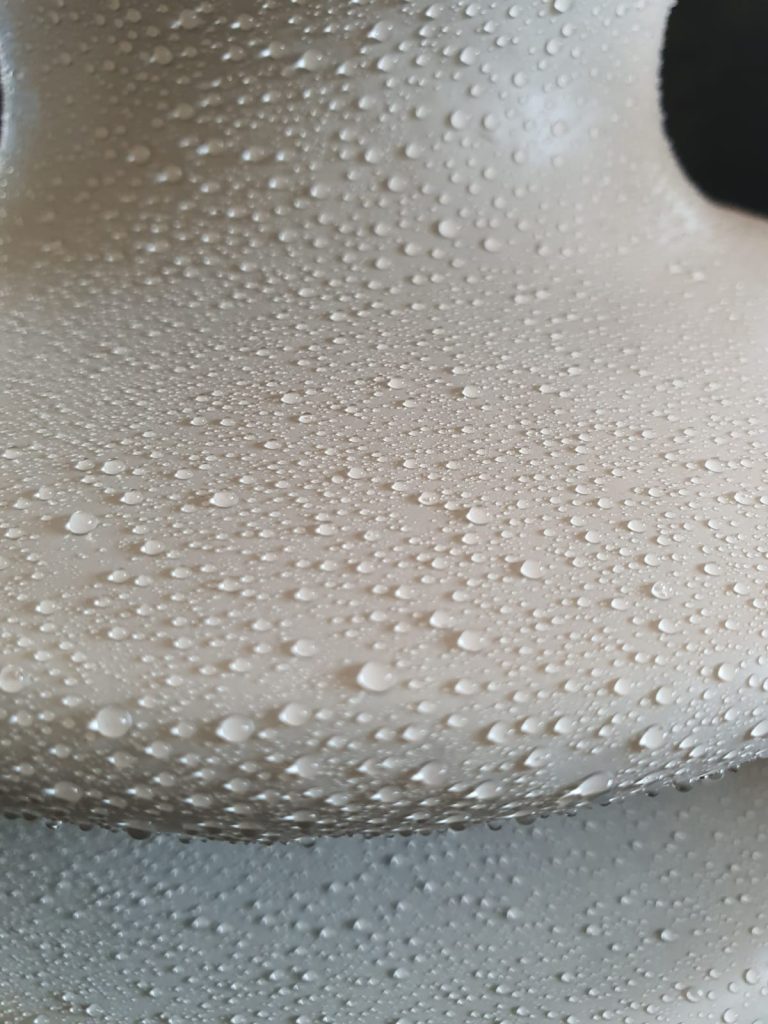
Moisture and surface contamination are persistent risk factors for outdoor insulation. When a continuous water film forms on an insulator, it can create conductive paths, elevate leakage current, and increase the likelihood of surface tracking and flashover—especially under polluted or coastal conditions. A hydrophobic, silicone‑based high‑voltage insulator coating (HVIC) changes that surface physics: water beads and rolls off instead of wetting, and contaminants are far less able to dissolve into conductive electrolyte layers.
What engineers mean by “hydrophobicity”
Hydrophobicity quantifies water repellency. At the surface, the contact angle between a water droplet and the solid is used as a practical metric. Hydrophobic surfaces maintain high contact angles and a low tendency for droplet spreading; superhydrophobic surfaces exhibit contact angles above ~150° with very low sliding angles, which dramatically reduces film formation and aids self‑cleaning.
Measured hydrophobicity on Si‑Coat 570hs HVIC
Si‑Coat 570hs reports water repellency angles per IEC 62073: Static 116°, Advancing 114°, Receding 92°. These values confirm persistent hydrophobicity under service‑representative measurement methods.
Why silicone HVIC improves insulator pollution performance
RTV (room‑temperature vulcanised) silicone coatings are widely deployed to upgrade porcelain and glass insulators in polluted environments. Their low surface energy prevents water from wetting the insulator; droplets remain discrete rather than forming conductive films. In addition, diffusion of low‑molecular‑weight silicone species can impart non‑wetting behaviour to deposited contaminants, weakening any electrolytic layer and thereby reducing leakage current. The net effect is higher flashover withstand and reduced maintenance compared to periodic washing or greasing.
Self‑cleaning: droplets do the dirty work
Hydrophobic silicone surfaces exhibit a self‑cleaning effect. Rolling droplets pick up particulates and carry them off the surface, limiting contaminant build‑up and stabilising electrical performance between maintenance cycles.
Certified performance and environmental durability
- Inclined Plane Tracking & Erosion (IEC 60587): PASS at 1A 4.5 and 1B 4.5
- UV & Salt Fog accelerated weathering (IEC 61109, 5,000 h): No degradation
- Hydrophobicity measurement (IEC 62073): angles as above
- Adhesion (IEEE 957 Water Blast): PASS; CEA LWIWG‑02 Boiling Water 100 h: PASS
- Tracking Wheel Withstand (CEA LWIWG‑01): >1,000 h
Electrical properties
Under standard conditions (7 days cure), Si‑Coat 570hs reports:
- Dielectric strength ≈ 718 V/mil (≈ 283 kV/cm at 0.054 cm)
- Volume resistivity ≈ 5.96×10¹⁶ Ω·cm
- Surface resistivity ≈ 1.26×10¹⁶ Ω/□
- Dielectric constant ≈ 3.13 (100 Hz) to 3.05 (100 kHz)
Application notes
- Substrates: glass, porcelain, HTV/LSR silicone, EPDM
- Surface preparation: high‑pressure water washing (≈3,000 psi at 8–10 gpm); solvent wipe for greased surfaces
- Application methods: airless spray, brush, or dip
- Typical DFT ≈ 15 mil (≈380 μm); minimum 10 mil, max ≈ 50 mil
- Ambient 5–60 °C; substrate 5–130 °C
- Cure profile: skin‑over 20–25 min; tack‑free 30–40 min; through‑cure ≈ 6 h; full properties ≈ 7 days
Where Si‑Coat 570 excels
570hs is designed for AC/DC systems across substations and lines, and for heavy pollution corridors (salt spray/fog, industrial particulates, desert sand). Its measured hydrophobicity, tracking/erosion resistance, adhesion and UV/salt endurance suit coastal and industrial routes that demand reduced washing frequency and stronger flashover margins.
