Warehouses and shopping centres carry some of the biggest roofs in the country. For that reason, a leak or a hot roof costs more here than almost anywhere else. A silicone roof coating in South Africa gives these flat and low slope roofs a seamless, reflective membrane that sits happily under ponding water. In this article we look at why SI-COAT 461 RC from CSL Silicones works on steel, concrete and existing coated roofs, and what the technical data actually says.
Why Flat and Steel Roofs Fail
Most large commercial buildings use steel sheeting, concrete decks or torch on membranes. These roofs face the same handful of stresses year after year:
- Ponding water on flat sections after summer storms
- Thermal cycling that opens and closes laps, fasteners and joints
- Strong UV that breaks down many organic coatings
- Salt air on the coast and big temperature swings inland
Most acrylic coatings are not designed to sit under standing water, so they soften and lose adhesion where water ponds. Many polyurethane systems, on the other hand, need a primer and a UV stable topcoat, which adds labour and time on the roof. As a result, facility managers often end up recoating far sooner than they planned. You can read the full comparison in our article on acrylic vs PU vs silicone roof coatings.
Why a Silicone Roof Coating Suits Warehouse Roofs in South Africa
SI-COAT 461 RC is a high solids silicone roof coating with 94% volume solids. Because there is so little solvent, almost everything you apply stays on the roof as cured film. According to the CSL Silicones technical data sheet, it offers:
- Ponding water protection. The TDS states it withstands ponding water. For more on this, see our guide to ponding water on a flat roof.
- Movement capacity. Elongation at break is 282% at 23°C and 330% at minus 18°C, so the film moves with the roof instead of cracking.
- Temperature stability. The cured film stays stable from minus 60°C to 200°C.
- Breathability. With a permeance of 4.44 perms, trapped moisture can escape, which reduces blistering.
- Durability. CSL describes excellent durability, colour stability and chalk resistance.
Reflectivity and Roof Temperature
Engineers increasingly specify roofs by their Solar Reflectance Index (SRI). The white SI-COAT 461 RC carries a CRRC rating (product ID 1368-0002) with an initial solar reflectance of 0.856, thermal emittance of 0.89 and an SRI of 107.9. After weathering, the soiled values still come in at a solar reflectance of 0.723 and an SRI of 88.9. In practice, a CSL case study recorded temperatures 7 to 9°C cooler inside the building after coating. On a large warehouse or mall, a silicone roof coating in South Africa therefore makes a real dent in cooling load. Our article on heat reflective roof paint explains how SRI works.
What the Silicone Roof Coating Bonds To
SI-COAT 461 RC needs no primer on most common roof substrates. However, CSL recommends a quick field adhesion test before you start. Typical substrates for a silicone roof coating on warehouses and shopping centres in South Africa include:
- Steel roof sheeting
- Concrete decks
- Torch on and other bituminous membranes, always with a primer first
- Existing coated roofs
On smooth surfaces, metal and existing coatings, always do an adhesion test patch first. If the result is not good enough, CSL Silicones supplies a compatible primer and you repeat the test. Also note that 461 RC is not for asphalt shingles.
How Silicone Roof Coating Is Applied in South Africa
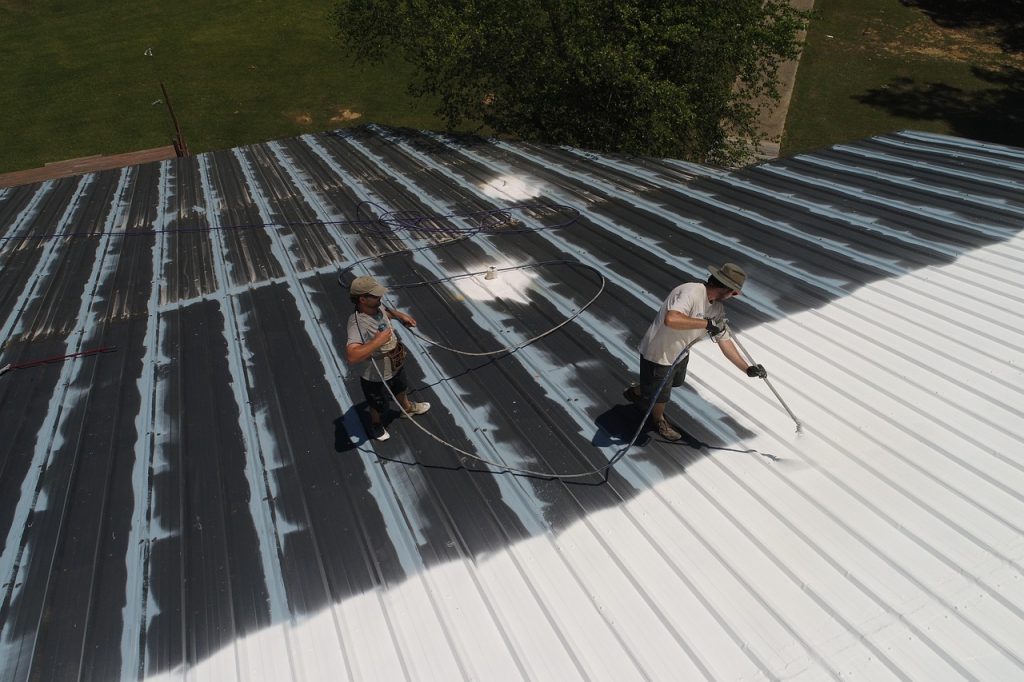
Good preparation matters more than anything else. First, power wash the roof with a suitable detergent, rinse it and let it dry. Next, apply when the air and surface are between 5°C and 60°C and at least 3°C above the dew point. The target is at least half a millimetre once dry (20 mil, 508 µm), which works out to roughly half a litre per square metre before losses.
Airless spray is the recommended method. Apply it as a single coat, building the full thickness with wet on wet passes before the first pass skins over. Brush and roller also work, but they need extra passes to reach the same thickness, again wet on wet in the same session. In terms of coverage, allow about 2.1 m²/L at 18 mil DFT and 1.7 m²/L at 22 mil DFT, plus a loss factor for the roof profile.
For timing, a 20 mil film skins over in about 68 minutes. It is dry, cured and ready to recoat in 4 to 6 hours, with full properties after 7 days. One last point for maintenance teams: a wet silicone roof is slippery, so plan safe walkways.
Service Life and Maintenance
CSL reports 461 roofs in service in North America for more than 20 years. Because silicone does not break down under UV the way many organic coatings do, maintenance is usually a matter of keeping the roof clean and touching up mechanical damage. In addition, a sound silicone roof can be recoated with silicone when the time comes, without stripping the old system. For warehouses and shopping centres in South Africa, a silicone roof coating therefore means fewer shutdowns and less disruption to tenants.
SI-COAT 461 RC also holds ASTM D6694, UL, Title 24 and Miami Dade listings, and the white carries NSF P151 for rainwater catchment. For a wider view of the options, read our complete guide to roof waterproofing or compare silicone vs liquid rubber on flat roofs.
Silicone Roof Coating FAQ for South Africa
Does silicone roof coating need a primer?
Not on most common substrates. Bitumen and torch on membranes are the exception and always need a primer first. Still, CSL recommends a field adhesion test, especially on smooth, metal and existing coated roofs. If the test fails, CSL supplies a compatible primer.
How long does it last?
CSL reports 461 roofs in service in North America for more than 20 years. Correct thickness and good preparation are what get you there.
Can it handle ponding water?
Yes. The TDS states SI-COAT 461 RC withstands ponding water, which makes it a good fit for flat roofs that hold water after storms.
Will a silicone roof coating cut cooling costs in South Africa?
It reduces heat gain through the roof. The white has an initial SRI of 107.9, and a CSL case study recorded 7 to 9°C cooler conditions inside. The actual saving depends on insulation, ventilation and how the building is cooled.
How much solvent does it contain?
Very little. SI-COAT 461 RC has 94% volume solids, so nearly all of the applied material stays on the roof as cured coating.
Where does silicone roof coating work best in South Africa?
It suits warehouses, shopping centres, logistics hubs, factories and mines with flat or low slope roofs. For more answers, see the SI-COAT 461 RC FAQ.
Talk to Us About Your Roof
Technical Solution Supplies distributes CSL Silicones products across Southern Africa, including the DRC and the Seychelles. Contact us for technical advice on SI-COAT 461 RC or to arrange a site visit.