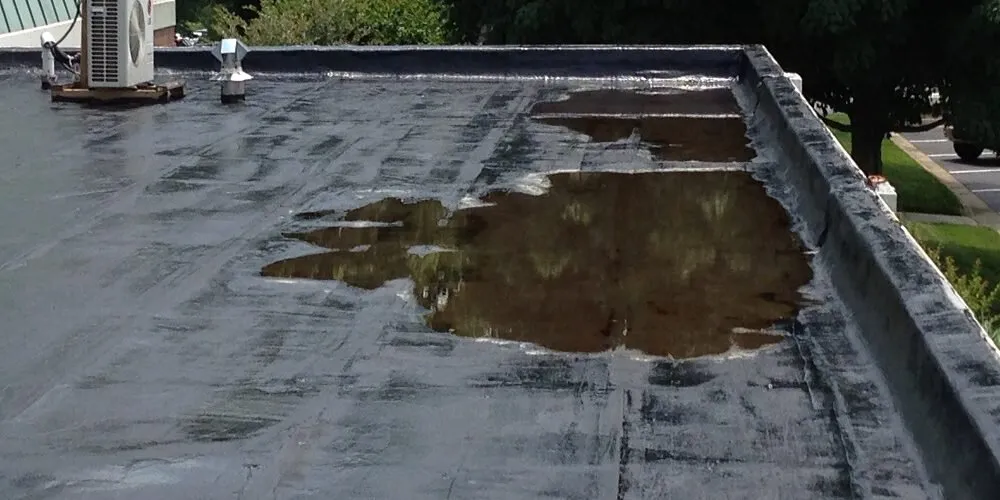
Ponding Water on a Flat Roof: Why Most Coatings Fail and What Actually Works
Flat roofs hold water. It is not a defect — it is a design reality. When drainage is slow, blocked, or simply insufficient for the roof’s deflection pattern, water sits. The question is not whether your coating will face ponding water. The question is whether it was built to handle it.
Most aren’t.
What Ponding Water Actually Does to a Roof Coating
Ponding water is defined as standing water that remains on a roof surface for more than 48 hours after rainfall. On flat and low-slope roofs, it occurs regularly due to insufficient falls, structural deflection, blocked drainage points, or settlement in older buildings.
The problem is not the water itself. The problem is what prolonged immersion does to coating chemistry that was never designed for it.
Acrylic roof coatings are water-based. Continuous immersion causes re-emulsification — the cured film begins to absorb water, soften, and lose adhesion. Once that process starts, failure spreads rapidly across the coating surface. Patch repairs become a recurring cost rather than a one-time fix.
Polyurethane systems face similar limitations. Many soften and blister under constant moisture exposure, losing mechanical properties well before their expected service life. The result is premature recoating, unplanned maintenance spend, and ongoing disruption to building operations.
The coating chemistry was not wrong for roofs in general. It was wrong for this specific condition — and ponding water is one of the most common conditions flat roofs in South Africa face.
Why Silicone Chemistry Solves the Problem
Silicone polymers are inherently hydrophobic. Water does not cause them to swell, soften, or degrade. This is not a marketing claim — it is a function of the polymer’s molecular structure. The Si-O backbone of a silicone chain is chemically stable in the presence of water, UV radiation, and temperature extremes simultaneously. Where acrylic and polyurethane systems degrade under these combined stresses, silicone maintains its physical properties.
SI-COAT 461 RC is a 100% silicone, RTV moisture-cure roof coating developed by CSL Silicones and tested to ASTM D6694 — the Standard Specification for Liquid-Applied Silicone Coating used in roofing systems. Its TDS lists ponding water resistance as an explicit key feature: it withstands permanent ponding water without affecting cured material characteristics.
That is a documented, testable performance claim — not a specification assumption.
The Breathability Factor
There is a second failure mode that ponding water triggers, and it is less obvious. Roof substrates — particularly on older buildings undergoing refurbishment — frequently contain residual moisture. When a non-breathable coating is applied over a substrate with trapped moisture, that moisture has nowhere to go. Blistering and delamination follow as vapour pressure builds beneath the coating film.
SI-COAT 461 RC has a measured permeance of 4.44 perms per ASTM E96/E96M. It is breathable. Vapour escapes through the cured coating without liquid water penetrating inward. This balance matters specifically on older flat roofs where the moisture history of the substrate is uncertain — which describes most commercial and industrial refurbishment projects in Southern Africa.
What the Standards Say
CSL SILICONES SI-COAT 461 RC carries the following independent certifications:
ASTM D6694 — liquid-applied silicone coating standard for roofing systems. FM Approved. UL Certified (R40482). Cool Roof Rating Council rated (Product ID 1368-0002) with an initial solar reflectance of 0.856 and thermal emittance of 0.89.
These are not self-reported values. They are independently verified performance ratings against internationally recognised standards. For facility managers and building owners specifying roof restoration, this removes the guesswork from product selection.
Designing Around Reality, Not Around Ideal Conditions
Eliminating ponding water on an existing flat roof is often impractical. Re-grading, structural alterations, and additional drainage points are costly and disruptive. Most building owners and facility managers are not looking to rebuild their roof — they are looking to protect it and extend its service life without major capital expenditure.
The correct response is not to specify a coating that assumes ideal drainage conditions and hope for the best. It is to select a coating that was engineered specifically for the conditions that exist.
SI-COAT 461 RC applies in a single coat at 20 mils dry film thickness. It bonds to metal, concrete, polyurethane foam, and previously coated surfaces without a primer in most cases. It tolerates an application temperature range of 5 to 60°C, making it suitable across Southern Africa’s full climate range from coastal humidity to inland heat.
Where drainage cannot be fixed, the coating can be. That is the technical solution.
Frequently Asked Questions
What is ponding water and why is it a problem for flat roofs?
Ponding water refers to standing water that remains on a roof surface for more than 48 hours after rainfall. It occurs on flat and low-slope roofs due to insufficient falls, structural deflection, blocked drainage, or settlement. It is a problem because most roof coatings are not designed for continuous immersion — prolonged exposure causes re-emulsification, adhesion loss, blistering, and premature failure in acrylic and polyurethane systems.
Can SI-COAT 461 RC be applied over a roof that already has ponding water issues?
Yes. SI-COAT 461 RC is specifically formulated to withstand permanent ponding water without affecting cured material characteristics. It does not require drainage issues to be resolved before application, making it suitable for roofs where eliminating standing water entirely is impractical or cost-prohibitive.
Why do acrylic roof coatings fail under ponding water?
Acrylic coatings are water-based. Continuous immersion causes the cured film to re-emulsify — absorbing water, softening, and losing adhesion. This is a chemistry limitation, not an application error. Once breakdown begins, failures spread across the coating surface and patch repairs become a recurring cost.
What standard does SI-COAT 461 RC meet for silicone roof coatings?
SI-COAT 461 RC is tested to ASTM D6694, the Standard Specification for Liquid-Applied Silicone Coating used in spray polyurethane foam roofing systems. It is also FM Approved, UL Certified, and rated by the Cool Roof Rating Council (CRRC Product ID 1368-0002).
Is SI-COAT 461 RC breathable?
Yes. SI-COAT 461 RC has a measured permeance of 4.44 perms per ASTM E96/E96M. This allows water vapour to escape from the substrate while preventing liquid water ingress, reducing the risk of blistering caused by trapped moisture — particularly important on older roofs with uncertain moisture history.
Where is SI-COAT 461 RC available in Southern Africa?
Technical Solutions Supplies is the exclusive Sub-Saharan Africa distributor for CSL Silicones. Contact TSS directly for pricing, technical support, and supply across Southern Africa.