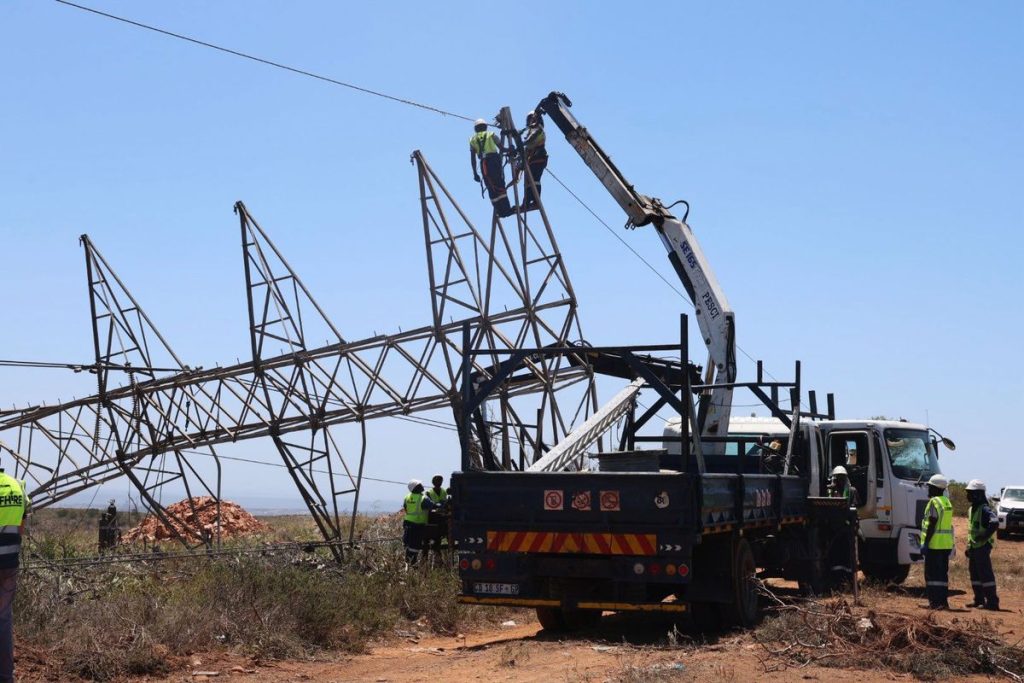
Transmission tower corrosion is one of the most underestimated threats to electricity infrastructure across Sub-Saharan Africa. While load shedding dominates headlines, a quieter crisis unfolds on steel lattice towers across the continent. Specifically, it develops over years, gives ample warning, and remains almost entirely preventable. The events in Nelson Mandela Bay between 2024 and 2026 prove exactly what happens when that warning goes unheeded.
What Is Transmission Tower Corrosion and Why Does It Matter?
Transmission tower corrosion is the progressive electrochemical degradation of structural steel in electricity pylons and lattice towers. Steel degrades because moisture, oxygen and atmospheric contaminants attack its surface over time. Left unmanaged, corrosion reduces the load-bearing capacity of the tower until structural failure becomes inevitable.
In less than two years, Nelson Mandela Bay suffered seven high-voltage transmission pylon collapses. Four 132kV towers fell in August 2024, leaving Summerstrand without power for nearly two weeks. A further collapse in January 2026 plunged half the city into darkness. A seventh collapse followed in March 2026, again cutting power to close to half of Gqeberha. Critically, the municipality had already received internal reports confirming that the pylons had reached the end of their design life. Corrosion had done its work while maintenance budgets went unallocated.
The cost of addressing the problem is now estimated at R35-million to upgrade the Chelsea-Summerstrand-Arlington line alone. That figure does not include the Bloemendal-Greenbushes and Chatty-Rowallan Park lines, which carry an additional estimated R9-million repair bill.
In essence, this is not an isolated case. Across Sub-Saharan Africa, transmission infrastructure faces the same pattern of deferred maintenance and accelerating structural degradation. As a result, the consequences are predictable, measurable and preventable.
Why Sub-Saharan Africa Accelerates Transmission Tower Corrosion
Steel transmission towers carry a design life of between 40 and 60 years under standard environmental conditions. However, Sub-Saharan Africa presents a combination of corrosive stressors that dramatically shorten this lifespan.
In particular, coastal proximity ranks among the most aggressive drivers. Salt-laden air attacks steel surfaces continuously, spreading electrochemical corrosion cells at a rate far higher than in inland environments. Cities like Gqeberha, Dar es Salaam, Maputo and Beira all sit within high-salinity corrosion zones where conventional coating systems face constant attack. Furthermore, high humidity compounds the coastal threat. Wet-dry cycling allows moisture to penetrate micro-cracks in coating films, accelerating corrosion beneath the surface layer.
Inland environments present a different but equally serious challenge. Industrial pollution from mining and smelting operations in Zambia, the DRC and Zimbabwe introduces sulphur dioxide and particulate matter into the atmosphere. These react with moisture to form weak acids that attack protective coatings and underlying steel with sustained intensity. For more on industrial corrosion in these environments, read our article on corrosion protection in Copperbelt mining.
Tropical UV radiation adds a further layer of degradation. Standard epoxy and alkyd-based coating systems degrade faster under Sub-Saharan UV levels than temperate climate data sheets predict. Once a coating system fails, bare steel faces direct environmental exposure and corrosion accelerates sharply. Consequently, transmission towers in this region frequently reach critical corrosion thresholds well before the end of their anticipated design life, particularly where maintenance cycles have been deferred or underfunded.
The Real Cost of Deferred Transmission Tower Corrosion Maintenance
Corrosion maintenance is typically treated as a discretionary budget item. In practice, however, deferring it is one of the most expensive decisions a utility or municipality can make.
Direct costs of a tower collapse include structural replacement, emergency civil works and line restoration. For a 132kV transmission line, these costs accumulate rapidly when multiple towers are affected. Each tower represents significant capital expenditure before labour, access equipment and traffic management are considered. In Nelson Mandela Bay, assessments now place the total infrastructure renewal cost across affected lines at over R44-million — a figure that dwarfs what a proactive corrosion maintenance programme would have cost.
Indirect costs are substantially larger. Extended power outages disrupt manufacturing, cold chain logistics, healthcare operations and commercial activity. Businesses suffer losses running into the millions. Moreover, insurance claims are frequently declined when failure stems from known and unaddressed maintenance deficiencies rather than unforeseen events. Municipalities and utilities therefore face potential litigation from affected businesses and residents.
The Nelson Mandela Bay collapses demonstrated this in stark terms. Political representatives noted that businesses faced insurance refusals precisely because investigators attributed the cause to neglect rather than an act of God. The reputational damage to the metro as an investment destination significantly compounded the direct economic loss.
Perhaps most critically, assessment reports on the Chelsea-Summerstrand-Arlington line concluded that corrosion on the pylons has made maintenance effectively impossible. The structures are now too unstable to safely access. Essentially, this is the endpoint of deferred corrosion maintenance — a point at which the only option is full replacement at maximum cost.
Consequently, deferred corrosion maintenance is not a cost saving. It is a cost transfer to a much larger and entirely avoidable future liability.
How Protective Coatings Prevent Transmission Tower Corrosion
The most effective and cost-efficient defence against transmission tower corrosion is a high-performance protective coating system, applied before structural degradation reaches a critical threshold.
Conventional coating systems, including zinc-rich epoxy primers and alkyd topcoats, provide adequate protection in moderate environments. However, they struggle to withstand the combined stressors of tropical humidity, coastal salinity and industrial atmospheric pollution over extended service periods. They also require abrasive blast cleaning to Sa2.5 standard for proper adhesion. On in-service structures, this is frequently impractical.
Silicone-based coating systems represent a significant advancement in corrosion protection for transmission infrastructure. Silicone chemistry offers properties that make it specifically well-suited to the Sub-Saharan African environment. Silicone coatings maintain integrity across a wider temperature range than organic systems. They also resist UV degradation far more effectively, retaining flexibility and adhesion under high-radiation conditions. Their hydrophobic surface properties actively shed moisture rather than allowing it to dwell on the steel surface. This behaviour reduces the electrochemical activity that drives corrosion. Additionally, silicone systems exhibit strong resistance to the acidic atmospheric conditions generated by industrial emissions.
Critically, surface-tolerant silicone coatings bond to steel prepared to St2 or St3 standard using hand tools and power tools. This makes proactive corrosion maintenance achievable on in-service structures without blast cleaning logistics that operational environments cannot accommodate. Technical guidance on silicone corrosion coating chemistry and application is available from CSL Silicones, the manufacturer of the SI-COAT range.
SI-COAT 579 CM: Silicone Corrosion Protection for Transmission Infrastructure
SI-COAT 579 CM is a single-component, moisture-cure RTV silicone corrosion maintenance coating developed by CSL Silicones. Technical Solutions Supplies distributes it exclusively across Sub-Saharan Africa. CSL specifically formulated it for structural steel in aggressive environments, including coastal zones, high-humidity regions and areas subject to industrial atmospheric pollution.
SI-COAT 579 CM bonds directly to steel prepared to St2 or St3 standard without a primer. It also applies in a single coat without a topcoat. This eliminates the three-coat system requirement of conventional high-performance coatings and makes proactive corrosion maintenance operationally and financially viable on structures where maintenance has historically faced deferral.
Its silicone base delivers permanent UV stability. Unlike conventional coatings, it does not chalk, yellow, crack or lose flexibility under prolonged UV exposure. As a silicone elastomer, it accommodates the micro-movement, vibration and thermal cycling that characterise in-service transmission structures. Conventional rigid coatings develop hairline cracks under this movement, allowing moisture to penetrate beneath the film. SI-COAT 579 CM maintains its integrity throughout.
Applied to correctly prepared steel, SI-COAT 579 CM provides corrosion resistance suitable for C3 and C4 corrosivity categories per ISO 12944. Furthermore, applied over a zinc phosphate epoxy primer, it achieves C5-M marine and C5-I industrial classification, the most stringent international standard for aggressive marine and industrial environments. Its service life exceeds 20 years in harsh outdoor conditions. By comparison, epoxy systems in the same environments require recoating every five to seven years.
For detailed technical specifications, visit the SI-COAT 579 CM FAQ or download the Technical Data Sheet directly from the product page. TSS also provides silicone corrosion protection solutions across the broader region. For context on how silicone coatings perform in similar high-humidity, high-salinity conditions, read our article on silicone coatings for corrosion protection in Namibia.
Corrosion Management as Infrastructure Strategy
The NMB pylon collapses are not an isolated failure. They are instead a visible symptom of a systemic approach that treats transmission tower corrosion protection as a discretionary line item rather than a structural requirement.
Across Sub-Saharan Africa, electricity utilities and municipalities manage ageing transmission networks under sustained budget pressure. In this environment, maintenance spend is frequently deferred in favour of more visible capital projects. Corrosion protection is particularly vulnerable to this pattern because it is invisible in its success and only apparent in its failure.
Nelson Mandela Bay demonstrates the cost of this approach in concrete terms. Refurbishing corroded pylons costs a fraction of collapse, emergency replacement and the economic damage that follows. By the time corrosion has progressed to the point where maintenance is no longer safely possible, the only remaining option is full replacement at full cost. Ultimately, the risk calculation is not complicated. It simply requires the institutional will to act before the next failure occurs.
Transmission tower corrosion will not resolve itself. The environmental conditions driving it are not diminishing. Therefore, for utilities, municipalities and infrastructure asset managers across the region, the question is not whether to invest in corrosion protection. It is whether to invest before or after the next collapse.
Frequently Asked Questions: Transmission Tower Corrosion
What causes transmission tower corrosion in Sub-Saharan Africa?
Transmission tower corrosion in Sub-Saharan Africa stems from a combination of coastal salt spray, high humidity, tropical UV radiation and industrial atmospheric pollution from mining and processing operations. These stressors, individually and in combination, attack conventional protective coating systems and accelerate the electrochemical degradation of structural steel.
How long do transmission towers last before corrosion becomes a structural problem?
Steel transmission towers carry a design life of 40 to 60 years under standard conditions. However, in high-corrosivity environments such as coastal or industrial zones across Sub-Saharan Africa, conventional epoxy-based coating systems typically require recoating every five to seven years. Without proactive maintenance, structural corrosion can therefore reach critical thresholds well before the end of the tower’s anticipated design life.
What is the best coating for transmission tower corrosion protection?
Silicone-based coatings offer superior performance compared to conventional epoxy and polyurethane systems in Sub-Saharan African environments. SI-COAT 579 CM is a surface-tolerant, single-coat silicone corrosion maintenance coating that bonds to St2 and St3 prepared steel without blasting. It provides a service life exceeding 20 years, permanent UV stability, flexibility under thermal cycling and resistance to acidic industrial atmospheres. Applied over a zinc phosphate epoxy primer, it achieves C5-M and C5-I classification under ISO 12944.
Can maintenance crews recoat transmission towers without taking them offline?
Yes. SI-COAT 579 CM suits in-service maintenance precisely because it bonds to steel prepared using hand tools and power tools to St2 or St3 standard, without abrasive blast cleaning. Maintenance teams can therefore carry out work during operational windows without decommissioning the tower or removing the line from service.
What does ISO 12944 mean for transmission tower corrosion protection?
ISO 12944 is the international standard for corrosion protection of steel structures by protective paint systems. It classifies environments by corrosivity category from C1 (very low) to C5 (very high), including C5-M for marine environments and C5-I for industrial environments. A coating system achieving C5-M or C5-I classification provides the highest level of protection against aggressive corrosion. SI-COAT 579 CM achieves C5-M and C5-I classification over a zinc phosphate epoxy primer.
How does the cost of corrosion prevention compare to the cost of tower collapse?
Proactive corrosion protection costs a fraction of collapse and emergency replacement. When indirect costs are included, such as business losses, insurance claim refusals, litigation and reputational damage, the economic case for preventive maintenance becomes overwhelming. Nelson Mandela Bay now faces over R44-million in transmission infrastructure renewal costs across multiple lines — all stemming from corrosion that was identified years before the first collapse occurred.
Technical Solutions Supplies is the exclusive Sub-Saharan Africa distributor for CSL Silicones. For more information on SI-COAT 579 CM and its application in transmission infrastructure protection, contact the TSS team directly.