
Air Core Reactor Coating at a 500 kV Substation
Air core reactor coating protects some of the most exposed equipment in a substation. Dry type air core reactors, static compensators and harmonic filters stand outdoors all year, with no enclosure against sun, rain, dust and pollution.
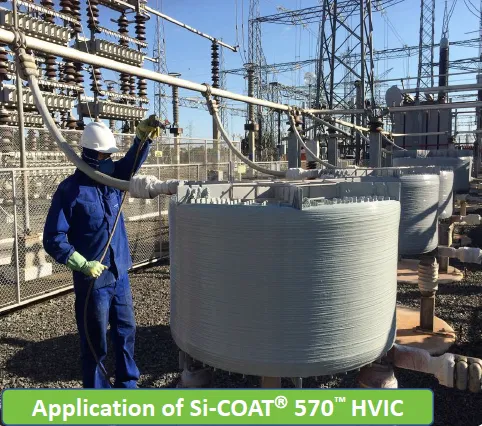
| Location | Goiás, Brazil |
|---|---|
| Utility | Furnas |
| Site | 500 kV substation |
| Equipment | Dry type air core reactors and static compensators CE01 and CE02 |
| Problem | Surface cracking after years outdoors |
| Product | Si-COAT 570 HS, RTV silicone |
| Service life | More than ten years, as reported by CSL |
So when their surface coating fails, the consequences are electrical as well as mechanical. CSL Silicones documented a clear example at a 500 kV substation in Goiás, Brazil, run by the utility Furnas. There, technicians repaired and recoated dry type air core reactors and two static compensators, CE01 and CE02, with Si-COAT 570 HS, an RTV silicone rubber coating. As a result, utilities and mines across Southern Africa now have a real reference for air core reactor coating.
Why air core reactor coating matters
Dry type air core reactors regulate current and voltage across transmission and distribution networks. Meanwhile, static compensators stabilise grid voltage, and harmonic filters remove unwanted frequencies. All three, however, stand exposed to weather and UV for decades. Once the coating cracks, moisture reaches the windings and insulation underneath. That moisture can then cause corrosion, weaker dielectric performance and unplanned outages. Thermal cycling also stresses rigid coatings, so the cracking speeds up over time.
The Furnas substation case study
Before recoating, the reactors and compensators at Goiás showed visible surface cracking. So CSL first repaired the damage. Technicians cleaned and treated the cracked surfaces, then filled and levelled them. Once the repair had cured, the team applied Si-COAT 570 HS over each whole unit. In the end, the finished air core reactor coating left a smooth, UV resistant surface on every reactor and compensator.
Epoxy vs silicone air core reactor coating
The site also gave a rare side by side comparison. Some units received an epoxy isocyanate coating after only a wash and an isopropyl alcohol wipe. Other units, including compensators CE01 and CE02, received Si-COAT 570 HS instead.
According to CSL, the RTV silicone gave better adhesion, resistance to UVA and UVB, and 180% elasticity. Because of that elasticity, the coated units can flex with thermal expansion instead of cracking. On that basis, CSL reports a service life of more than ten years for this application.
Benefits of air core reactor coating
The Goiás job shows what utilities can expect from a silicone air core reactor coating. First, UV resistance protects the surface under strong Southern African sun. Second, good adhesion keeps the coating intact through vibration and thermal cycling. Third, high elasticity lets it move with the unit rather than crack. Finally, a longer service life means fewer maintenance outages, which matters where every planned outage is costly.
What this means for Southern African utilities
Substations in South Africa, Zambia and Namibia run the same equipment in similar conditions. In addition, coastal humidity, mine dust and intense UV all speed up coating failure on unprotected units. So the Goiás case is a directly useful lesson for engineering teams at Eskom, ZESCO and NamPower.
Si-COAT 570 HS also has its own test record. On coated insulators, it passed both IEC TR 62730 tests, the 5,000 hour multiple stress test and the tracking and erosion wheel test, at independent accredited high voltage laboratories. You can read the results on our IEC TR 62730 test results page, and the full reports are available from TSS on request. For product details, see our Si-COAT 570 HS insulator coating page, or browse our high voltage equipment care articles.
Download the CSL case study (PDF)
Frequently asked questions about air core reactor coating
What is air core reactor coating?
It is a protective surface coating for dry type air core reactors, static compensators and harmonic filters. It shields these units from UV damage, surface cracking and moisture getting in.
Why did the Goiás substation need recoating?
After years outdoors, the reactors and static compensators there had developed surface cracking. So CSL repaired the cracks first, then applied an RTV silicone coating to restore protection.
How does Si-COAT 570 HS compare with epoxy?
According to CSL’s case study, Si-COAT 570 HS offers 180% elasticity and resists UVA and UVB. So it flexes with the unit rather than cracking, unlike more rigid epoxy coatings.
Can this coating go on South African substations?
Yes. Substations in South Africa, Zambia and Namibia face similar UV and thermal cycling. Therefore, the same RTV silicone used at Goiás suits local air core reactors, static compensators and harmonic filters.
What are the advantages of air core reactor coating?
It shields windings and insulation from UV, moisture and surface cracking. As a result, coated units avoid the corrosion and dielectric problems that cracked, unprotected units tend to develop.
What types of air core reactor coating suit high voltage work?
RTV silicone coatings such as Si-COAT 570 HS suit high voltage work because they combine UV resistance with high elasticity. Unlike rigid epoxy, they flex with thermal cycling instead of cracking.
Who supplies air core reactor coating in South Africa?
Technical Solution Supplies distributes CSL Silicones products across Southern Africa, including the DRC and the Seychelles. TSS supplies Si-COAT 570 HS with technical support and application guidance. So utilities get the coating and the technical backing from one supplier.
What does air core reactor coating cost?
Cost depends on equipment size, surface condition and site access. Even so, coating usually costs far less than the long outages and equipment replacement that untreated cracking eventually causes. For a price on your units, request a quote.
More high voltage articles
- Insulator Grease or Silicone Coating? A Guide for Substation Maintenance Planners

- Shunt Reactor Insulator Protection: Preventing Flashover on Transmission Equipment

- Insulator Coating for Mines: Preventing Flashover on Africa’s Mine-Owned Power Infrastructure
- RTV Insulator Coating Southern Africa: 18 Years of Proof at Duinefontein

- South Africa’s New Transmission Grid: Why Every New Substation Needs High Voltage Insulator Coating From Day One
- Insulator Washing: Why Scheduled Maintenance Alone Is Not Enough to Prevent Flashover



Send us the problem
Photos and a rough size are enough to start, while drawings and specs can follow later. Then we come back with the right product and a quote.