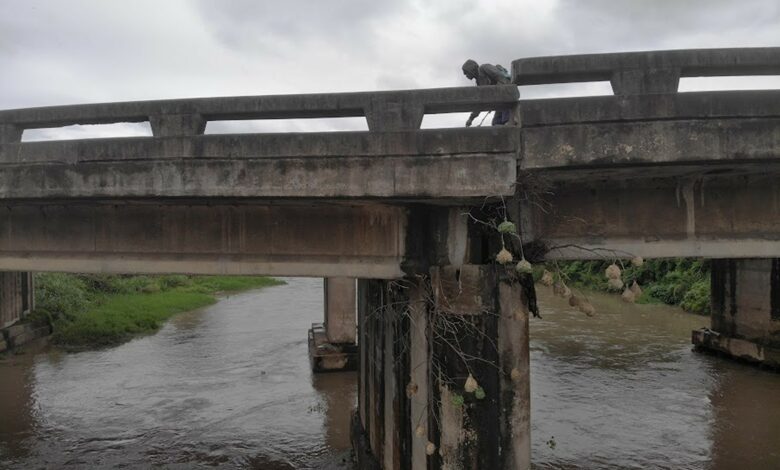
Photo: South Coast Sun
In November 2024, the Ezimbokodweni River Bridge on the N2 south of Durban partially collapsed. SANRAL’s investigation identified a clear cause: corrosion of the steel reinforcement inside the concrete bearings had advanced until they failed. Nine months earlier, the bridge had scored 98% on its last formal inspection.
Emergency procurement, three-hour traffic delays and a two-phase repair programme followed, with costs running into tens of millions of rands. The incident made headlines. However, it should not have been a surprise.
South Africa’s Bridge Corrosion Problem Is Structural and Growing
South Africa has thousands of bridges and overpasses across its national, provincial and municipal road networks. A significant number were designed and built in the 1950s, 60s and 70s. The construction technologies used then are no longer adequate for the corrosive environments these structures now face.
Concrete bridges from that era used steel-reinforced concrete bearings. Engineers now widely acknowledge these components as inherently vulnerable to corrosion-driven failure. The design has since been replaced, but the bridges remain in service.
Furthermore, the environment has become more demanding. South Africa’s coastal zones subject steel structures to aggressive chloride attack. Inland industrial zones expose structural steel to airborne pollutants, acid rain and wide thermal cycling. Roads now carry far heavier freight than originally designed. Consequently, vibration and micro-cracking open pathways for moisture and oxygen — the two ingredients corrosion requires.
Additionally, SANRAL recently absorbed 3,099 km of provincial roads described officially as being in “paltry” condition. Its own bridge condition metric, targeting 95%, came in at 89% last financial year. The maintenance backlog is real, large and getting worse.
Why Traditional Coatings Are Failing on South Africa’s Bridges
The conventional approach to protecting structural steel on bridges uses a three-coat system: zinc-rich primer, epoxy intermediate coat and polyurethane topcoat. However, bridge maintenance is not performed in the ideal conditions these systems require.
Access to bridge steelwork is difficult and expensive. Traffic disruption during maintenance is a major constraint. Abrasive blasting on an active road structure generates dust, debris and noise, creating logistical, safety and regulatory complications. Furthermore, a full three-coat system requires multiple mobilisations, dry conditions and strict surface temperature parameters.
In practice, maintenance is deferred until coating failure becomes visibly severe. By the time work is authorised and contracted, the steel beneath has already corroded significantly. The process is expensive and disruptive, so it gets deferred again. Ultimately, the cycle compounds.
Traditional coatings carry another weakness in South Africa’s climate. Polyurethane and epoxy systems are rigid. They do not accommodate micro-movement in bridge structures as traffic loads shift, temperatures cycle and concrete creeps. Hairline cracks develop in the coating and moisture enters. Corrosion then proceeds under the film, often invisibly until it is advanced. For more on why conventional coating systems fail in Sub-Saharan conditions, read our article on corrosion maintenance coating for St2 and St3 steel.
What SI-COAT 579 CM Does Differently for Bridge Corrosion Protection
SI-COAT 579 CM is a single-component, moisture-cure RTV silicone corrosion maintenance coating developed by CSL Silicones. Technical Solutions Supplies distributes it exclusively across Sub-Saharan Africa. CSL specifically designed it for real-world maintenance situations that traditional systems cannot efficiently serve.
SI-COAT 579 CM bonds directly to hand-prepared or power tool-cleaned steel without a primer. On bridge maintenance projects where full blast cleaning is impractical, this is not a minor convenience. It is what makes the job possible. Standard maintenance crews with standard equipment can therefore meet the surface preparation requirement without specialist blast cleaning logistics.
One application provides both corrosion protection and a finished surface. No primer staging, no intermediate coat and no inter-coat windows are required. This matters significantly for bridge maintenance where access is constrained and traffic windows are limited. The difference between one coat and three is often the difference between a project that proceeds and one that never does.
As a silicone elastomer, 579 CM remains permanently flexible after cure. It accommodates micro-movement, vibration and thermal cycling that cause rigid coatings to crack. This eliminates the hidden corrosion pathways that develop beneath failed epoxy films.
Unlike organic coatings, silicone does not oxidise, hydrolyse or degrade under UV exposure. A correctly applied 579 CM system will not chalk, yellow, crack or embrittle under South Africa’s intense solar radiation. It will not fail at the resin level in marine environments. Consequently, its protective properties outlast conventional paint systems by a significant margin.
Where Bridge Corrosion Does the Most Damage
The most corrosion-vulnerable areas on a bridge are also the most difficult to access and maintain. Understanding where bridge corrosion protection matters most helps asset owners and engineers prioritise their maintenance programmes effectively.
Beam ends and bearing zones are exactly where the N2 Ezimbokodweni failure occurred. These areas experience concentrated moisture accumulation, poor air circulation and contamination from road drainage. They are also the most structurally critical. Specifically, a coating applicable during planned maintenance shutdowns, without full blasting, protects these areas in a way the conventional maintenance cycle cannot.
Fascia girders and parapets are visible, weather-exposed and subject to chloride deposition in coastal zones. The UV stability of 579 CM means it holds surface integrity over years of direct sun and rain. Unlike conventional systems, it does not chalk or delaminate along KwaZulu-Natal and Western Cape coastlines.
Steel box sections and under-deck structural members receive the least maintenance attention due to access constraints. However, they accumulate moisture and develop hidden corrosion. The single-coat, self-priming nature of 579 CM makes it practical to address these areas during routine maintenance rather than waiting for a full rehabilitation contract.
Expansion joint zones carry concentrated movement where rigid coatings fail first. The elastomeric flexibility of 579 CM maintains integrity precisely where other coatings crack.
Proactive Maintenance vs Emergency Rehabilitation: The Cost Argument
The N2 bridge partial collapse resulted in emergency procurement, a two-phase repair programme and three-hour traffic delays during peak commuter and freight periods. SANRAL’s R5-billion N2 upgrade package was already in the procurement pipeline. The corrosion-related failure simply forced the timetable. Consequently, deferred bridge maintenance leads to expensive emergency intervention, or accelerated full rehabilitation at a fraction of the asset’s intended service life. Moreover, this pattern repeats across South Africa’s road and rail network. For more on the cost consequences of deferred corrosion maintenance, read our article on transmission tower corrosion.
The value of 579 CM is not only in the protection it provides to the steel. It is also in the maintenance intervention it makes economically and practically feasible. When maintenance is simple enough to actually happen — when crews can mobilise, work within traffic windows and complete the job with standard equipment — the protective intervention occurs. That is what breaks the deferral cycle. That, ultimately, is what prevents structural failure.
For detailed technical specifications and application guidance, visit the SI-COAT 579 CM FAQ.
Frequently Asked Questions: Bridge Corrosion Protection
What is the best coating for structural steel on South African bridges?
The most effective long-term option for maintenance conditions in South Africa is a single-component silicone corrosion coating such as SI-COAT 579 CM. Unlike epoxy and polyurethane systems, silicone remains permanently flexible, is UV stable without a topcoat, and does not require abrasive blasting. This makes it practical for in-service bridge maintenance where access and traffic management are constraints.
Can you coat rusted steel without sandblasting?
Yes. SI-COAT 579 CM bonds directly to steel cleaned by hand tool or power tool methods to remove loose scale, active rust and surface contamination. Full abrasive blasting is not required, making it suitable for bridges, overpasses and elevated structures in service. Additionally, it applies to previously coated surfaces where the existing coating remains sound.
How long does a silicone corrosion coating last on a bridge?
On correctly prepared steel in South African conditions, SI-COAT 579 CM delivers a service life that significantly exceeds conventional epoxy and polyurethane systems. Silicone chemistry does not degrade under UV exposure. It does not embrittle in coastal chloride environments. It does not crack under structural movement. These are the three primary failure mechanisms that limit the lifespan of organic coatings on bridge structures.
Why do bridge coatings fail prematurely in South Africa?
The main causes are UV degradation of organic coating resins, cracking from structural movement and thermal cycling, and chloride attack in coastal zones. Rigid coatings such as epoxy develop hairline cracks as the structure moves, allowing moisture to penetrate beneath the film. Silicone coatings are not subject to these failure mechanisms. Consequently, they maintain structural protection long after conventional coatings have failed.
Is SI-COAT 579 CM suitable for coastal bridge structures in KwaZulu-Natal and the Western Cape?
Yes. The silicone chemistry in 579 CM resists chloride attack and does not hydrolyse or degrade in marine environments. It is specifically suited to the high-humidity, high-UV, high-chloride conditions found along South Africa’s coastlines. Conventional coatings in these environments have a significantly reduced service life.
What surface preparation is required before applying 579 CM to bridge steelwork?
The minimum requirement is hand tool or power tool cleaning to remove loose rust, loose mill scale and surface contamination. The steel does not need blast cleaning to Sa2.5 or white metal standard. Specifically, this is a critical practical advantage on bridge maintenance projects where abrasive blasting is logistically constrained or not permitted under traffic management conditions.
Technical Solutions Supplies is the exclusive Sub-Saharan Africa distributor for CSL Silicones. For more information on SI-COAT 579 CM and its application for structural steel on South African bridge infrastructure, contact the TSS team directly.