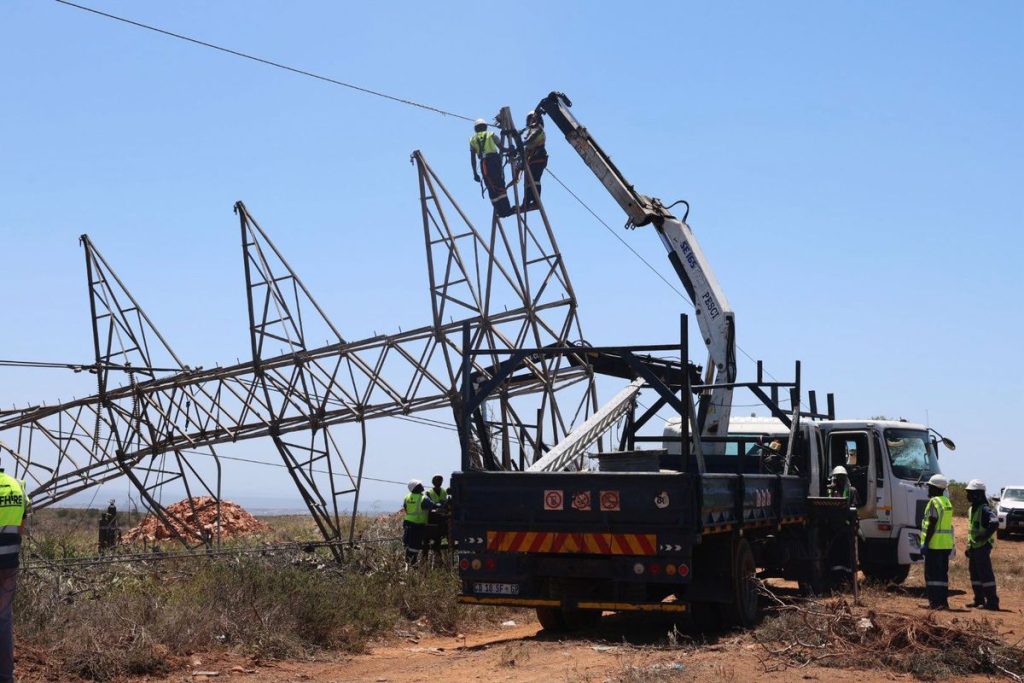
One of the 132 kV transmission towers that collapsed in January 2026. (Photo: Facebook / Nelson Mandela Bay Municipality)
Transmission tower corrosion is one of the most underrated threats to electricity supply in Southern Africa. It builds up over years, gives plenty of warning, and is largely preventable. Yet when maintenance slips, the warning signs go unheeded until a tower comes down. Nelson Mandela Bay shows exactly how that plays out.
What Transmission Tower Corrosion Does
Most lattice towers have a hot dip galvanised coating. The zinc corrodes slowly in place of the steel and protects it for years. However, salt, humidity and industrial pollution all eat the zinc faster. Once the zinc is gone, the bare steel starts to rust, and section loss begins at members, bolts and connections. Left alone, that loss cuts the load capacity of the tower until it can no longer carry wind and conductor loads.
Nelson Mandela Bay: Seven Collapses in Two Years
By March 2026, Nelson Mandela Bay had lost seven high voltage transmission pylons in under two years. The seventh, on the Summerstrand-Arlington 132 kV line, cut power to close to half of Gqeberha. A week later, another pylon on the same line came down, with restoration expected to take about three weeks.
Not every collapse was down to rust. Reports put the August 2024 collapses down to gale force winds, and the metro blamed January 2026 on vandalism and high winds. Corrosion on the Chelsea-Summerstrand-Arlington line, however, has a clear paper trail. In May 2025, a side arm on one of its towers snapped because of corrosion. Furthermore, a municipal report says officials knew of advanced corrosion on these pylons as far back as 2016. In addition, Nersa found clear signs of neglect when it audited the metro’s electricity network in October 2025.
Why Transmission Tower Corrosion Is Worse Here
Coastal air is the biggest driver. Salt settles on the steel, attracts moisture and keeps corrosion cells active far longer than inland. Gqeberha, Durban, Maputo, Beira and Dar es Salaam all sit in high salinity zones. Furthermore, high humidity and daily wet and dry cycles speed up the attack on the zinc and on any paint above it.
Inland, the threat changes. Mining and smelting in Zambia, the DRC and Zimbabwe release sulphur dioxide, which forms weak acids with moisture. These attack galvanising and coatings alike, as our article on corrosion protection in copper mining explains. On top of that, strong UV breaks down many organic paint systems faster than temperate data suggests. Once a coating fails, the steel underneath corrodes quickly.
The Cost of Deferring Maintenance
Many owners treat corrosion maintenance as a budget item that can wait. In practice, however, waiting is the expensive option. Nelson Mandela Bay has already spent R17.3 million on pylon repairs and recovery since 2024, and its own reports put the urgent refurbishment need at R35 million. Meanwhile, the outages hit homes, businesses, water supply and the metro’s reputation as an investment destination.
Therefore, deferred maintenance is not a saving. Instead, it moves the cost to a later date, when it is far larger and the line is already down.
Stopping Transmission Tower Corrosion With Silicone
The cheapest time to protect a tower is before section loss sets in. Conventional maintenance systems usually need abrasive blasting, a primer, an intermediate coat and a topcoat. On a working network, blasting at height brings containment, access and outage problems. As a result, many owners keep putting the job off.
Silicone changes that. A surface tolerant silicone coating goes onto hand or power tool cleaned steel, so there is no blasting. It stays flexible under wind vibration and thermal cycling, and it sheds water rather than holding it against the steel. For more on preparing steel without blasting, see our guide to surface tolerant coating.
Si-COAT 579 CM on Lattice Towers
Si-COAT 579 CM is a single component, moisture cure RTV silicone corrosion maintenance coating made by CSL Silicones. It goes onto steel prepared by hand or power tool cleaning to SSPC SP2 or SP3 (similar to ISO St2 and St3), or by water jetting to SSPC SP12 WJ-4. In addition, it has excellent tolerance to airborne chemical exposure, which suits towers near industry.
Lattice towers are all edges, bolts and connections, and that is where coatings fail first. So first, stripe coat every edge, weld and bolt at about 0.13 mm (5 mil, 127 microns). Then apply the full coat at 0.2 to 0.5 mm dry film thickness (8 to 20 mil, 203 to 508 microns). Under standard conditions, it is tack free in about 60 minutes and reaches full properties in 7 days.
There is a practical bonus on bolted structures. At mining shows, we have shown visitors how cured 579 strips cleanly off bolt threads. So a fitter can undo a coated bolt, replace a member and simply recoat the area afterwards. There is no need to torch old coating off the threads.
For aggressive coastal and industrial sites, CSL also offers a system build. Si-COAT 579 CM over CSL 979 primer passed ISO 12944-6 at C5 High durability. That result applies to the system with the primer, not to 579 on its own. Also note that 579 is for above ground steel only, never immersion.
Proven on Transmission Towers
Si-COAT 579 CM leads with test data. In a three year Florida Fence test at Melbourne Beach, it outperformed 28 other coatings, and the TDS reports a pass after 36 months with a scribe. For service life, 579 went onto process piping at the De Bary power plant in Florida in 2003. About 20 years later, CSL inspected it and found the dry film thickness unchanged.
On towers specifically, Reliant Energy, which runs about 8,000 transmission towers around Galveston Bay in Texas, used 579 on its towers there. The utility cut project timelines from about four months to six weeks and avoided the health problems its crews had with epoxy mastics. After more than 36 months, the coating still looked like new.
In Morocco, contractor Net Elec reported in 2022 that 579 had protected national grid (ONEE) pylons and concrete posts for five years. Compared with blasting, priming and a multi coat system, it saved them both time and cost. See more on our case studies page.
Transmission Tower Corrosion FAQ
What causes it in Southern Africa?
Coastal salt, humidity, UV and industrial pollution all wear away the galvanising and any paint above it. After that, the bare steel corrodes and loses section.
How long before corrosion becomes a structural problem?
It depends on the environment and how long the galvanising lasts. Coastal and industrial towers reach that point far sooner than inland ones. So regular inspection of members, bolts and connections matters more than any rule of thumb.
What is the best coating for lattice towers?
For maintenance on working towers, a surface tolerant silicone such as Si-COAT 579 CM suits the job, because it needs no blasting and stays flexible. For the harshest coastal and industrial sites, specify 579 over CSL 979 primer as a system. We also suggest a field adhesion test on any weathered galvanising first.
Does the line have to come out of service?
That is the utility’s decision under its own safety rules. However, with no blasting, there is no grit, containment or heavy equipment at height. As a result, the work fits more easily into planned outage windows.
Do the insulators need attention too?
Often, yes. Polluted coastal and industrial air also causes flashover on insulators. Our high voltage insulator coatings page covers Si-COAT 570 for that job.
How does prevention compare with a collapse?
Recoating a tower costs far less than rebuilding one. In Nelson Mandela Bay, repairs have already cost the metro R17.3 million, with at least R35 million needed for urgent refurbishment. For technical detail on the coating, see the Si-COAT 579 CM FAQ.
Technical Solution Supplies distributes CSL Silicones products across Southern Africa, including the DRC and the Seychelles. To discuss a tower or line, contact us. For related reading, see our article on silicone coatings for corrosion protection in Namibia.
Proud exclusive distributor of CSL Silicones in Southern Africa.
Pingback: Bridge Corrosion Protection: Why South Africa's Bridges Are Failing