C5 Coating System Test Results
A C5 coating system has to protect steel in very high corrosivity atmospheres, the C5 category of ISO 12944. The Si-COAT CM System passed independent testing for C5 High, on hand cleaned steel.
The system pairs CSL 979 primer with Si-COAT 579 CM, both made by CSL Silicones. TSS supplies them across Southern Africa, including the DRC and the Seychelles.
What a C5 coating system has to survive
ISO 12944 sorts atmospheres from C1, very low, up to C5, very high, plus CX for extreme offshore and tropical sites. C5 covers coastal areas with high salinity and industrial areas with high humidity and an aggressive atmosphere.
The second part of the rating is durability. Here, High means about 15 to 25 years before the first major maintenance. However, ISO 12944 treats that as a planning range, not a guarantee.
The two coats in the system
First comes CSL 979, a two pack epoxy primer that wets into the surface and anchors the system. It goes on at 0.15 mm dry film (150 microns, 6 mil).
Next, Si-COAT 579 CM goes over it at another 0.15 mm (150 microns, 6 mil). This silicone topcoat stays flexible, sheds water and holds its colour in strong UV. Together, the system builds 0.3 mm (300 microns, 12 mil) in total.
C5 coating system test results
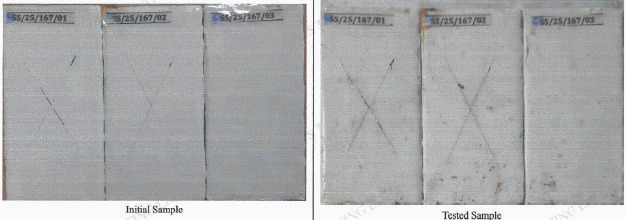
The main test was ISO 12944-6:2018 cyclic corrosion, run for 1,680 hours over 10 cycles. During those cycles, the panels went through UV, salt spray, condensation and low temperature exposure. Afterwards, they showed no blistering, rusting, cracking or flaking. As a result, the system was fully compliant with C5 High.
The other tests backed that up. For example, 2,500 hours of ASTM B117 salt spray left no blistering or rusting, and the scribe line held. Similarly, 1,000 hours at 38°C in the ASTM D2247 humidity test caused no damage. In addition, adhesion scored 5A, the top rating in ASTM D3359, before and after ageing.
The system also passed 1,000 cycles of Taber abrasion with a 1 kg load, with low weight loss. Finally, electrochemical impedance testing to ISO 16773-2 showed high impedance, which points to a tight barrier against corrosion.
Hand cleaned steel, not blasted
This is the part that matters most for maintenance work. CSL has confirmed that the test steel under the primer had only hand cleaning, not abrasive blasting.
In practice, that means you can reach C5 High on a running plant, where blasting is often off the table. On the other hand, Si-COAT 579 CM on its own does not carry an ISO 12944 rating. So for C5 sites, specify the full system, with CSL 979 underneath.
Where the C5 coating system fits in Southern Africa
Think of harbour cranes and hoppers in Durban, chemical plants at Richards Bay, or tank farms near the coast. Similarly, smelters and acid plants inland can reach C5 through fumes and humidity alone.
For lighter sites, Si-COAT 579 CM alone, applied in one coat, often does the job. Its record includes the Florida Fence Test and a process piping job still sound after 20 years.
For full product details, see our silicone corrosion coating page, or read the Durban harbour hopper case study.
Send us the problem
Photos and a rough size are enough to start, while drawings and specs can follow later. Then we come back with the right product and a quote.