
Fuel Tank Coating: Florida Power & Light Case Study
A fuel tank coating on the coast has to beat salt, humidity and fierce sun at the same time. In December 2002, Florida Power & Light put one coat of Si-COAT 579 CM on an 85 m heated fuel oil tank at its West Palm Beach terminal, and the job cost about half of a conventional system.
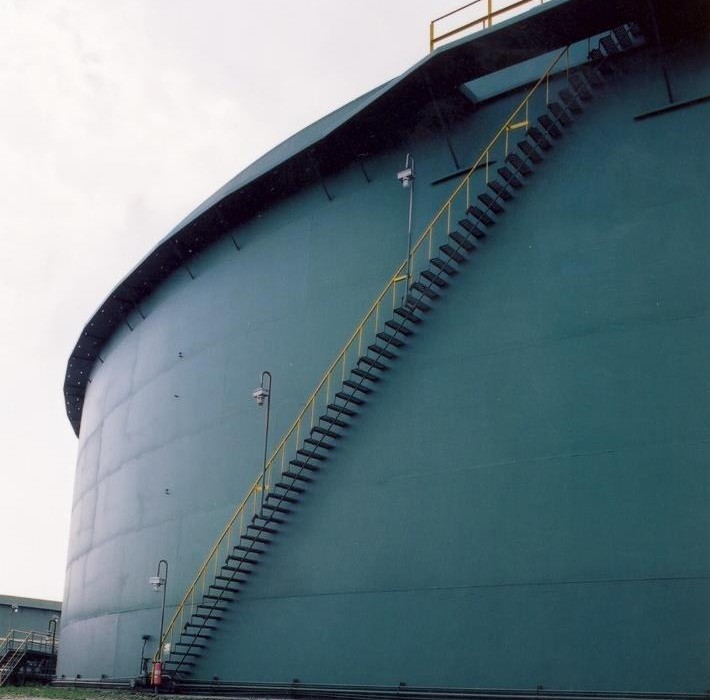
| Owner | Florida Power & Light, a large US power utility |
|---|---|
| Site | West Palm Beach fuel terminal, Florida, USA |
| Asset | Heated fuel oil storage tank, 85 m diameter and 17 m high, exterior wall |
| Area | About 4,500 m² |
| Installed | December 2002 |
| Product | Si-COAT 579 CM, custom colour match |
| Exposure | Coastal salt, high humidity, heat and strong UV |
Why the old fuel tank coating failed
The tank carried a water based acrylic paint. Within five years, that paint was peeling and the steel under it showed isolated, deep pit rusting. On top of that, the colour had faded badly. So the utility had a corrosion problem and a looks problem on one of its biggest tanks.
Florida explains why. The state gets about 3,000 hours of sun a year, along with salt fog and high humidity. As a result, many paints chalk, fade and lose their grip within a few seasons. The utility’s lead corrosion engineer could have repainted every couple of years. However, that cost money every time, and he wanted something that would last.
A coating chosen by testing 29 of them
Before touching the tank, the utility’s corrosion laboratory shortlisted 29 coatings for a three year exposure test at Melbourne Beach, Florida. The list included two and three coat epoxy and urethane systems, polysiloxane epoxy copolymers, alkyds and organic zincs. First, the lab rusted every steel panel in a salt fog chamber. Then it cleaned them by hand tools to SSPC SP2 and coated them to each maker’s instructions, primers included.
Next, the lab scribed an X through each coating to bare steel and left the panels on the beach for three years. In the end, only three coatings stood apart from the rest. Two alkyds resisted creep at the scribe, but they faded and showed bleed through rust. Si-COAT 579 CM, the only one coat system in the test, showed no creep, no bleed through and no loss of colour. The salt residue on it simply wiped off. You can read the full results on our Florida Fence Test page.
Surface preparation without blasting the whole tank
Kenny Manta Company of Lakeland, Florida, did the work over the Christmas period of 2002. The crew abrasive blasted only the areas of heavy pit rusting. After that, they spot primed those areas with 579 CM itself, at about 0.15 mm (6 mil, 152 microns) dry.
For the rest of the tank, a pressure wash was enough. The crew washed it at about 345 bar (5,000 psi) with a turbo tip, which cleaned the surface and stripped any loose paint. Because 579 CM tolerates prepared rust and sound old coatings, nobody had to blast 4,500 m² of steel back to white metal. Our surface tolerant coating guide covers this kind of preparation in more detail.
Applying the fuel tank coating
The crew sprayed 579 CM by airless spray to a final dry film of about 0.18 mm (7 mil, 178 microns). Over the old pit rust, they built it up to about 0.3 mm (12 mil, 305 microns). Apart from those extra passes on the pits, the whole tank got one coat.
The colour mattered as well. The utility wanted the tank to blend in with its neighbours, so the job used a custom colour match. In Southern Africa, TSS stocks 579 CM in white and ANSI grey, and any RAL colour is available to order.
Time and cost against a conventional system
The utility budgeted one week for the tank, since there was no full blast and only one coat. In practice, bad weather stretched the job to three weeks. Even so, that beat the two months or more that a conventional multi coat system would have needed.
Overall, the fuel tank coating job came in at about 50% of the cost of a traditional coating system. Both material and labour savings fed into that figure. Fewer coats meant less paint and fewer passes, while skipping the full blast cut out the biggest labour item on most tank jobs.
Fuel tank coating for Southern African terminals
Coastal tank farms in Durban, Richards Bay, Cape Town, Walvis Bay and Maputo face the same mix of salt, humidity and sun. Inland, mines and power stations add dust, chemical fallout and big daily temperature swings. For these sites, a fuel tank coating that goes on in one coat over prepared rust shortens shutdowns and cuts scaffold time.
Florida Power & Light is not the only reference. Hellenic Petroleum coated a crude oil tank in Greece with 579 CM after a water wash, with no blasting. You can read that job in our Hellenic Petroleum case study. Meanwhile, on process piping at a Florida power plant, CSL measured the 579 CM film about 20 years after application and found no loss of thickness. For more on tank farms, see our article on silicone coating for petroleum tanks.
Where 579 CM fits, and where it doesn’t
Si-COAT 579 CM is for above ground steel, including tank shells, roofs, pipework, stairs and handrails. It handles fuel drips and splashes on the outside of a tank. In a CSL test, a panel spent five months immersed in diesel, absorbed only 2.77% of its weight and showed no damage or delamination.
However, it is not a tank lining. Never use it inside a tank, under immersion, on buried steel or in bunds that hold spills. For those, specify a lining system rated for immersion. Also, where a site needs a rated system for C5 High conditions, use the Si-COAT CM System with CSL 979 primer.
Fuel tank coating FAQ
Is Si-COAT 579 CM a fuel tank coating for exteriors?
Yes. It protects the outside of above ground fuel and oil tanks, including shells, roofs and stairways. It also handles drips and splashes of fuel. By contrast, it is not a lining for tank interiors.
Does the whole tank need blasting first?
No. On this job, the crew blasted only the deep pits and pressure washed the rest. In general, 579 CM goes onto steel cleaned to SSPC SP2 or SP3, or water jetted to SSPC SP12 WJ-4. Loose rust and flaking paint must still come off.
How thick does the coating go on?
On this tank, the crew applied the fuel tank coating at about 0.18 mm (7 mil) dry in one coat, and about 0.3 mm (12 mil) over old pit rust. The 579 CM FAQ and the data sheet give the full range.
Where can I get Si-COAT 579 CM in Southern Africa?
Technical Solution Supplies distributes CSL Silicones products across Southern Africa, including the DRC and the Seychelles. For data sheets, samples and pricing, request a quote with photos of your tank and its size.
More corrosion case studies and articles
- First, the silicone corrosion coating product page.
- Also, all our case studies, from fertiliser plants to Durban harbour.
- Next, the CODELCO acid tank case study in Chile.
- Finally, our article on transmission tower corrosion, another utility problem.
Proud exclusive distributor of CSL Silicones in Southern Africa.
Send us the problem
Photos and a rough size are enough to start, while drawings and specs can follow later. Then we come back with the right product and a quote.