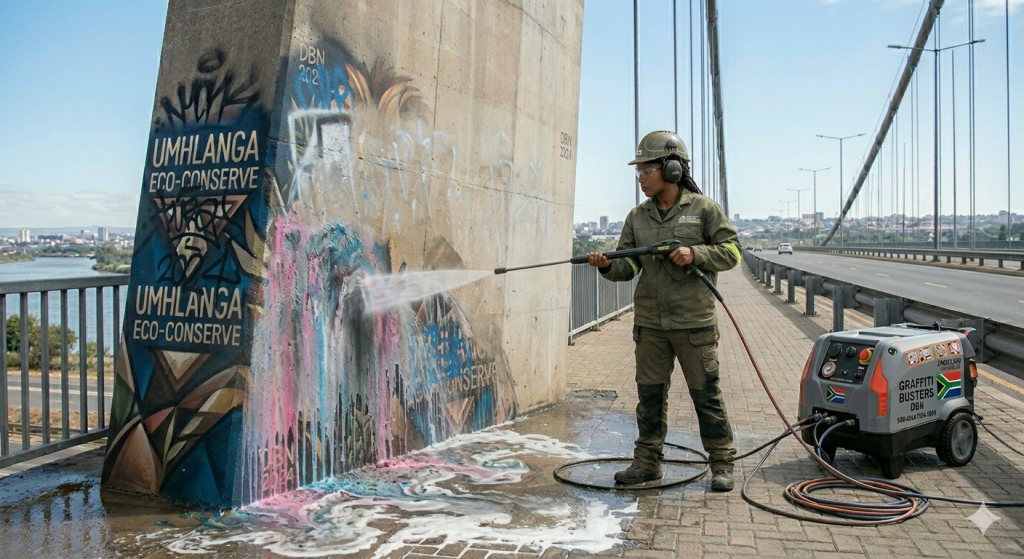
South Africa has a graffiti problem that goes far beyond aesthetics. Railway stations, bridge abutments, highway infrastructure, municipal buildings, and public transport facilities across the country are tagged repeatedly, cleaned at significant cost, and tagged again. The cycle never ends — and the financial toll is staggering.
South Africa’s Passenger Rail Agency (PRASA) has absorbed over R7.64 billion in losses from theft and vandalism over five years, with graffiti forming part of a wider infrastructure degradation crisis that saw more than 80% of its stations damaged. In Cape Town, the Central City Improvement District (CCID) lists graffiti removal as one of its core ongoing operational services — a permanent line item in the management of one of Africa’s most visited city centres.
The graffiti removal cycle in South Africa is costly, chemical-dependent, and ultimately ineffective without a permanent protective solution in place. SI-COAT 528AG, supplied exclusively across Sub-Saharan Africa by TSS, ends that cycle with a single permanent application. These real-world case studies show exactly how it works.
South Africa’s Graffiti Crisis: The Scale of the Problem
Railway infrastructure tells the story most clearly. The Brenthurst Foundation has described South African rail stations and bridge pillars as covered in graffiti, emblematic of the broader infrastructure decline that has cost the country billions in lost productivity and repair costs. PRASA’s recovery programme — funded by over R38 billion in government capital since 2021 — is restoring corridors across Gauteng and the Western Cape, but the surfaces being restored are immediately vulnerable to retagging without permanent protective treatment.
Cape Town faces a particular challenge. The city is investing a record R39.7 billion in infrastructure over three years, the largest municipal infrastructure investment in South Africa’s history. Bridges, public transport facilities, retaining walls, and civic buildings form a significant part of that investment. Without permanent anti-graffiti protection, newly constructed and restored surfaces enter the same removal cycle that has plagued Cape Town’s urban environment for decades.
The Cape Town CCID, which manages the city’s central business district on behalf of property owners and the municipality, maintains graffiti removal as a permanent operational service. The CCID’s annual revenue exceeds R114 million, with graffiti removal representing a recurring cost that grows proportionally with the surface area it manages.
The environmental cost compounds the financial one. Chemical solvents used in conventional graffiti removal enter Cape Town’s stormwater systems and threaten the biodiversity of the city’s unique urban ecology. In a city that takes its environmental credentials seriously, the repeated application of harsh chemicals to thousands of square metres of public surface is no longer an acceptable status quo.
SI-COAT 528AG offers a permanent, water-only alternative proven across some of the world’s most graffiti-pressured infrastructure environments.
Case Study 1: President George Bush Turnpike, Dallas, Texas
Highway infrastructure carries some of the highest graffiti pressure of any built environment. High visibility, easy access from road level, and large uninterrupted concrete surfaces make highway retaining walls and bridge abutments prime targets for graffiti tagging across every country in the world.
The President George Bush Turnpike in Dallas, Texas, presented exactly this challenge across thousands of square metres of decorative concrete retaining walls. The walls form a visible and architecturally significant part of the highway corridor, and repeated graffiti tagging was damaging both their appearance and the investment made in their construction.
SI-COAT 528AG was specified for the turnpike’s retaining wall system, applied directly to the decorative concrete substrate without primer or abrasive blasting. The result is permanent protection across the full surface area, with graffiti removed by cold water pressure washing at 1,200 psi whenever tags appear. No chemical solvents are required, and the coating itself requires no reapplication after each removal cycle.
For South Africa’s highway infrastructure — the N1, N2, N3, and the urban freeway systems running through Johannesburg, Cape Town, and Durban — this case study demonstrates a directly applicable solution. South Africa’s National Roads Agency (SANRAL) manages thousands of kilometres of highway retaining walls and bridge structures that face persistent graffiti pressure in urban and peri-urban areas.
Case Study 2: Royal Recreation Trail, Guelph, Ontario
Bridge underpasses are among the most heavily tagged structures in any urban environment. Protected from rain, accessible on foot, and largely out of sight of passing traffic, underpasses attract persistent graffiti activity in cities across the world. Before SI-COAT 528AG was applied to the Royal Recreation Trail underpass in Guelph, Ontario, the concrete surfaces beneath the bridge were heavily covered in multicoloured graffiti tags — a familiar sight under bridges and overpasses across South Africa’s urban areas.
After application of SI-COAT 528AG, the before-and-after transformation is dramatic. The concrete surfaces are clean, even-toned, and visually restored. More importantly, when new tags appear, they are removed with cold water and the coating remains intact — no repainting, no chemical treatment, no reapplication of protective product.
For South Africa, this case study speaks directly to bridge infrastructure in Cape Town, Johannesburg, Durban, and Pretoria, where highway underpasses, railway bridges, and pedestrian overpasses face unrelenting graffiti pressure. The City of Cape Town’s R39.7 billion infrastructure investment includes significant bridge and transport infrastructure — surfaces that will face immediate graffiti pressure upon completion without permanent protective treatment.
Case Study 3: City of Duarte, California
Municipal welcome structures and civic signage represent a particular challenge for property managers and municipalities. These surfaces are high-visibility by design — they are intended to project a positive image of the city to residents and visitors. When they are tagged with graffiti, the reputational impact extends beyond the cost of removal.
The City of Duarte in California specified SI-COAT 528AG for its municipal welcome wall following repeated graffiti incidents on the unprotected concrete surface. The before photograph shows a deteriorating, tagged surface that undermines the civic message the wall was designed to communicate. The after photograph, taken following SI-COAT 528AG application, shows a clean, restored surface that reflects the standard of civic investment the city intended.
South African municipalities managing public-facing infrastructure — welcome signs, civic centres, community facilities, transport interchanges, and public parks — face precisely the same challenge. Cape Town’s CCID, which exists specifically to maintain the appearance and functionality of the city’s CBD, operates in an environment where graffiti removal is a permanent operational cost. SI-COAT 528AG converts that recurring cost into a one-time capital investment.
Case Study 4: Rue du Fort Tunnel, Montreal, Quebec
The Rue du Fort tunnel case study is perhaps the most visually compelling demonstration of SI-COAT 528AG’s performance. The before photograph shows a tunnel wall heavily covered in graffiti tags — exactly the condition seen in road tunnels and underpasses across South Africa’s major cities. The after photograph shows a worker in high-visibility gear removing graffiti from the SI-COAT 528AG-protected surface using nothing more than a cold water pressure washer.
No chemical solvents. No protective equipment beyond standard work gear. No damage to the underlying surface. Just water.
This is the operational reality of SI-COAT 528AG in daily use — maintenance crews can remove graffiti quickly, safely, and without chemical exposure, using equipment they already own. For South African municipalities and facility managers, this translates directly into lower operational costs, reduced chemical procurement, and a safer working environment for maintenance staff.
Case Study 5: Metrolinx GO Station, Guelph, Ontario
Public transport infrastructure is a prime target for graffiti in South Africa, as PRASA’s experience has demonstrated so painfully. The Metrolinx GO Station in Guelph shows SI-COAT 528AG applied to the stone masonry walls of a busy public transport facility — exactly the type of application most relevant to South Africa’s railway recovery programme.
PRASA is currently restoring 40 rail corridors across the country, with the Cape Town Central Line among the priority projects receiving significant government investment. As stations are restored and new surfaces are constructed, the absence of permanent anti-graffiti protection means each restored surface immediately enters the removal cycle. SI-COAT 528AG applied at the time of construction or restoration converts a future operational liability into a protected, low-maintenance asset.
The Metrolinx application demonstrates that SI-COAT 528AG performs equally well on stone, brick, and masonry substrates — not just concrete — making it suitable for the full range of surface types found in South Africa’s diverse built environment.
Case Study 6: Pearson Airport Monorail, Toronto, Ontario
Large-scale transport infrastructure — elevated structures, monorail supports, bridge columns, and viaducts — presents a particular challenge for anti-graffiti management. The scale of surface area involved makes chemical removal programmes prohibitively expensive, and the height and access requirements of these structures add further cost and safety considerations to every removal operation.
The Pearson Airport Monorail structures in Toronto demonstrate SI-COAT 528AG applied across extensive concrete columns and elevated structural elements. The protection is permanent, the removal process requires only water, and the coating withstands the weathering and UV exposure inherent in large outdoor infrastructure environments. All SI-COAT 528AG colours are tested to withstand 5,000 hours of accelerated UV weathering — a critical performance requirement in South Africa’s high-UV environment.
For South Africa, this application type is directly relevant to the highway flyovers, railway viaducts, and elevated transport structures that are among the most visibly tagged surfaces in the country’s urban corridors.
The South African Case: Why Now Is the Right Time
South Africa is in the middle of the largest infrastructure investment cycle in its modern history. Cape Town alone is committing R39.7 billion to infrastructure over three years. PRASA is spending R38 billion restoring its rail network. SANRAL continues to invest in the national highway system. Municipalities across the country are building and restoring public facilities, transport interchanges, and civic structures.
Every rand invested in new and restored infrastructure is vulnerable to graffiti degradation from the day the surface is complete. The choice facing infrastructure owners, asset managers, and municipal decision-makers is simple: accept the permanent operational cost of chemical graffiti removal, or make a one-time investment in SI-COAT 528AG permanent protection.
The case studies documented here — highway infrastructure in Texas, recreation trail bridges in Ontario, municipal structures in California, tunnel walls in Montreal, and transport stations in Guelph and Toronto — demonstrate that SI-COAT 528AG delivers on its promise across every surface type, climate condition, and application scale relevant to South Africa’s infrastructure environment.
TSS supplies SI-COAT 528AG across South Africa and Sub-Saharan Africa as the exclusive distributor for CSL Silicones, an ISO 9001:2015 registered manufacturer with a proven international track record in permanent anti-graffiti protection.
Frequently Asked Questions
Is SI-COAT 528AG suitable for South Africa’s climate?
Yes. SI-COAT 528AG is tested to withstand 5,000 hours of accelerated UV weathering and maintains temperature stability from minus 60 to plus 200 degrees Celsius. South Africa’s high UV index, temperature extremes, and coastal salt exposure are well within the coating’s performance envelope.
Can SI-COAT 528AG be applied to railway station structures?
Yes. SI-COAT 528AG bonds to concrete, brick, stone, metal, wood, and fiberglass without primer or abrasive blasting. Railway station walls, platforms, bridge abutments, and support structures are all suitable substrates. The Metrolinx GO Station case study demonstrates this application directly.
How does SI-COAT 528AG perform on bridge and tunnel surfaces?
Exceptionally well. The Royal Recreation Trail and Rue du Fort case studies both document SI-COAT 528AG protecting bridge and tunnel surfaces in demanding environments, with graffiti removed cleanly by cold water pressure washing after each tagging incident.
What is the total cost of ownership compared to ongoing chemical removal?
A single application of SI-COAT 528AG replaces an indefinite cycle of chemical removal product procurement, labour, and equipment costs. On high-pressure surfaces that are tagged frequently, the cost advantage of permanent protection over sacrificial or chemical removal programmes is substantial within the first few years. On newly constructed infrastructure, applying SI-COAT 528AG at construction stage is significantly more cost-effective than managing removal after the fact.
Can municipalities specify SI-COAT 528AG for new infrastructure projects?
Yes. TSS works with municipalities, infrastructure asset managers, and construction project teams to specify SI-COAT 528AG at the design and construction stage. Contact TSS for technical specifications and application guidance suitable for inclusion in project documentation.
Permanent Protection for South Africa’s Infrastructure Investment
South Africa is building and restoring infrastructure on a scale not seen in a generation. The surfaces being created today will face graffiti pressure from the moment they are complete. SI-COAT 528AG ensures that investment is protected permanently — one coat, water-only removal, no chemical solvents, no reapplication cycle.
To discuss SI-COAT 528AG for your infrastructure project, municipal facility, or commercial property, visit our SI-COAT 528AG anti-graffiti coating page, contact us through our contact us page, or visit our FAQ page. Proud distributors of CSL Silicones.