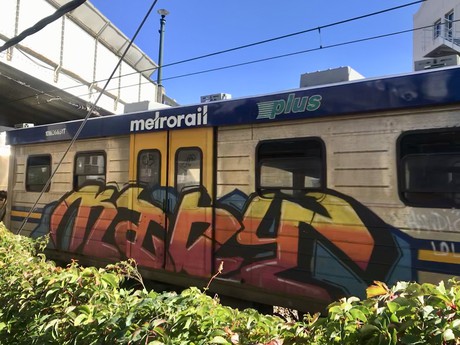
Photo: Brent Meersman/GroundUp
Graffiti removal cost is rarely a one-time expense. For Cape Town’s Central City Improvement District, it is a recurring line item that repeats month after month, year after year. Every tag removed today, whether from a building wall or a train carriage, simply clears the surface for the next one. Municipalities, rail operators, and property managers across South Africa face the same frustrating math: pay to clean, wait for the next attack, then pay again.
This cycle does not have to continue indefinitely. SI-COAT 528AG is a permanent, non-sacrificial silicone anti-graffiti coating, part of our full range of anti-graffiti coatings at /category/anti-graffiti-coatings/. TSS supplies it across South Africa as the exclusive Sub-Saharan Africa distributor for CSL Silicones. This article breaks down exactly what drives graffiti removal cost upward, and how a permanent coating changes the equation.
Understanding the True Graffiti Removal Cost for Cape Town’s CCID
The Cape Town Central City Improvement District manages graffiti removal as a permanent operational service, not an occasional cleanup. The CCID tracks these costs closely. In one month alone, graffiti removal in the Cape Town CBD cost the CCID just over R10,000 in material and labour. Multiply that figure across twelve months, and the annual burden becomes significant.
The CCID’s overall annual revenue exceeds R114 million, and graffiti removal draws directly from that budget every year. Furthermore, the City of Cape Town’s dedicated anti-graffiti unit has documented removing well over 17,000 square metres of graffiti in a single calendar year from public and City-owned buildings. That scale of repeated removal, spread across labour, equipment, and chemical products, adds up to a substantial and entirely avoidable annual spend.
Why Chemical Removal Never Ends the Cost Cycle
Chemical solvents break down graffiti paint so crews can wash or wipe it away. However, on unprotected concrete, brick, or painted masonry, this process leaves the surface more porous than before. As a result, the next tag bonds even more easily than the last one did. Consequently, the graffiti removal cost keeps climbing while the underlying surface keeps degrading.
Sacrificial anti-graffiti coatings offer partial relief, but contractors must strip and reapply them after every single cleaning cycle. The product cost and labour cost therefore never disappear. They simply repeat, month after month, tag after tag. For an organisation managing graffiti across an entire CBD, this repeating expense compounds quickly and never reaches a breakeven point.
SI-COAT 528AG: Converting Recurring Cost into One-Time Investment
SI-COAT 528AG bonds chemically to the host surface and remains in place through repeated graffiti removal cycles. Unlike sacrificial systems, contractors do not need to reapply it after cleaning. The coating is a single-component, room-temperature vulcanising silicone that cures through moisture in the air, forming a durable, semi-gloss film.
Removal itself is simple. Cold water at 1,200 psi lifts graffiti cleanly from the coated surface, without chemicals or solvents. If graffiti sits for more than ten days, a warm water pressure wash handles it instead. In rare cases involving specialty paints cured for extended periods, a biodegradable surfactant and a cleaning pad remove the residue before an immediate rinse. Most substrates need no abrasive blasting and no primer, which keeps application straightforward for concrete, brick, stone, metal, wood, fiberglass, and pre-existing coatings alike.
Because the coating does not need reapplication, the graffiti removal cost curve flattens after the first application. Municipalities, property managers, and infrastructure asset owners pay once, and the coating keeps working through every removal cycle that follows.
The Environmental Case Against Repeated Chemical Removal
Cape Town’s civic priorities place real weight on environmental stewardship, and repeated chemical graffiti removal works directly against that goal. Harsh solvents can enter stormwater systems, and applicators working in confined spaces face ongoing chemical exposure. SI-COAT 528AG removes that risk entirely, since cold water alone lifts graffiti from the protected surface.
The coating itself carries a low VOC rating of 70 grams per litre, meeting California’s SCAQMD standard, a recognised global benchmark for low-emission coatings. In addition, CSL Silicones tests every available colour to withstand 5,000 hours of accelerated UV weathering, so protected surfaces hold their appearance under Cape Town’s intense coastal sun.
Where the Cost Argument Matters Most
Municipal infrastructure across Cape Town, including retaining walls, underpasses, and public buildings, faces constant graffiti pressure in high-traffic areas. Every removal cycle on these surfaces adds to an already stretched municipal budget.
Rail infrastructure carries the same cost pressure, and often at a larger scale. PRASA, South Africa’s Passenger Rail Agency, has absorbed over R7.64 billion in losses from theft and vandalism over five years, and more than 80 percent of its stations suffered damage during COVID-19 lockdowns. PRASA is now restoring 40 rail corridors, with the Cape Town Central Line among the priority projects. Every restored platform, coach, and station wall becomes vulnerable to graffiti again the moment restoration finishes, unless a permanent coating protects it first. Applying SI-COAT 528AG during restoration, rather than after the first tag appears, avoids that cost entirely.
Meanwhile, commercial property managers running removal contracts on facades and perimeter walls face the same repeating invoice every time a tag appears.
Heritage buildings present a particular challenge, since aggressive chemical solvents can damage decorative finishes and sensitive masonry. SI-COAT 528AG’s water-only removal process avoids that risk entirely, protecting both the budget and the building fabric at the same time.
What drives graffiti removal cost up over time?
Repeated chemical cleaning, reapplication of sacrificial coatings, and rising labour costs all compound the graffiti removal cost over multiple years. Because unprotected or sacrificially coated surfaces require ongoing product and labour spend, the total cost accumulates indefinitely, with no natural endpoint.
Does a permanent coating really lower graffiti removal cost?
Yes. Crews apply a permanent, non-sacrificial coating like SI-COAT 528AG once, and it remains in place through repeated cleaning cycles. Property owners avoid the reapplication cost that sacrificial systems require after every single removal, which lowers the total cost over the life of the surface.
How does the CCID currently manage graffiti removal cost?
The CCID treats graffiti removal as a permanent operational service, deploying a dedicated removal team regularly across the Cape Town CBD. Material and labour costs recur every month, drawing from the CCID’s annual operating budget.
Can SI-COAT 528AG be applied to existing Cape Town infrastructure?
Yes. SI-COAT 528AG adheres to concrete, brick, stone, metal, wood, fiberglass, and most pre-existing coatings without abrasive blasting or a primer coat. Surfaces simply need to be clean and free of loose material before application.
Does graffiti removal cost affect Cape Town’s rail network too?
Yes. PRASA has absorbed over R7.64 billion in losses from theft and vandalism over five years, and graffiti removal forms part of that ongoing cost. As PRASA restores 40 rail corridors, including the Cape Town Central Line, coating platforms, coaches, and station walls during restoration prevents that cost from returning immediately.
Ending the Cycle in Cape Town
Graffiti removal cost will keep climbing for as long as Cape Town relies on chemical solvents and sacrificial coatings to manage the problem. SI-COAT 528AG offers a different path: one application, water-only removal, and a coating that keeps performing through every cleaning cycle that follows.
To find out more about SI-COAT 528AG and how it can reduce graffiti removal cost for your municipality, CBD precinct, or commercial property, visit our SI-COAT 528AG anti-graffiti coating page at /si-coat-528ag-anti-graffiti-coating/, contact us through /contact-us/, or visit our FAQ page at /faq/ for more information.
Proud distributors of CSL Silicones.
SI-COAT 528AG anti-graffiti coating protecting a graffiti-tagged train carriage and Cape Town CBD wall to reduce graffiti removal cost