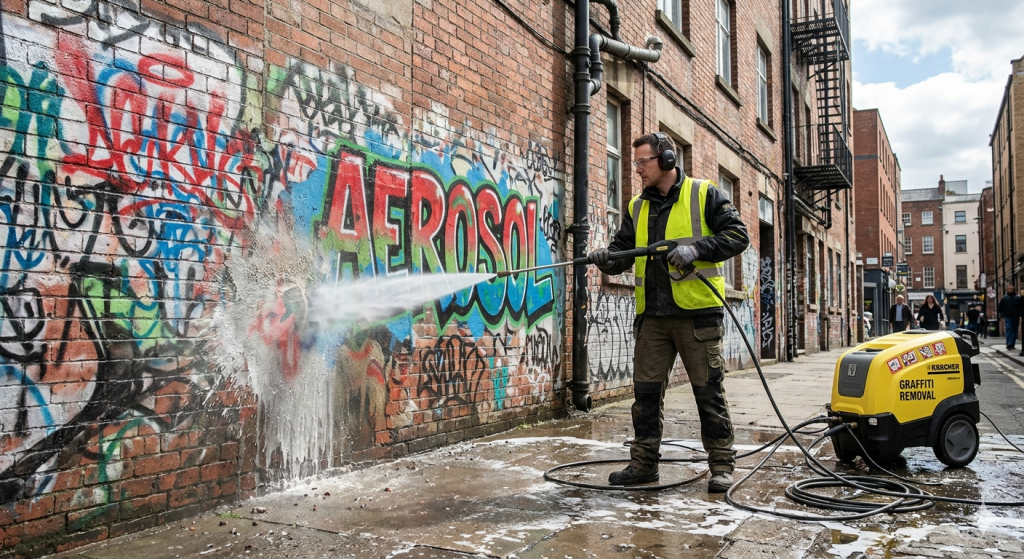
Graffiti removal in South Africa is a costly, never-ending battle for municipalities, commercial property owners, and facility managers. Walls are cleaned, tagged again within weeks, cleaned again, and the cycle repeats indefinitely. The chemicals used to strip graffiti are harsh, expensive, and damaging to surrounding environments — yet without a permanent solution in place, there is no way off the treadmill.
There is a better approach to graffiti removal in South Africa, and it starts with protecting surfaces before graffiti ever lands.
SI-COAT 528AG is a permanent, non-sacrificial silicone anti-graffiti coating that bonds chemically to surfaces and prevents graffiti from taking hold. When tags do appear, they are removed with nothing more than cold water at low pressure — no solvents, no chemicals, no environmental harm. TSS, the exclusive Sub-Saharan Africa distributor for CSL Silicones, supplies SI-COAT 528AG to municipalities, commercial property managers, and facility owners across South Africa.
The Real Cost of Graffiti Removal in South Africa
Graffiti is not simply an aesthetic problem. For property owners and municipalities managing large surface areas, it represents a significant and recurring operational cost. Chemical solvent removal products must be purchased repeatedly, application crews must be deployed after every incident, and the surfaces themselves are subjected to repeated chemical exposure that degrades the underlying substrate over time.
The cost of graffiti removal in South Africa compounds quickly when you account for the full picture. Labour costs for removal crews, chemical product procurement, equipment wear, and the management overhead of coordinating repeated interventions across multiple sites add up to a substantial annual spend — with nothing to show for it except surfaces that will be tagged again.
Beyond the financial cost, the environmental impact of repeated chemical graffiti removal is a growing concern, particularly in South Africa’s urban centres. Harsh solvents enter stormwater drainage systems, damage surrounding vegetation, and pose health risks to applicators working in confined or poorly ventilated spaces. In Cape Town, where environmental stewardship is a civic priority, the cumulative effect of chemical removal programmes across thousands of square metres of public and commercial surfaces is impossible to ignore.
Graffiti removal in South Africa will always be necessary. The question is whether it has to be this expensive and this damaging.
Why Chemical Graffiti Removal Is a Losing Strategy
Chemical removal products work by breaking down the paint or ink used in graffiti tagging, allowing it to be washed or wiped from the surface. On unprotected substrates such as bare concrete, brick, or painted masonry, this process is never clean. Solvents penetrate the surface along with the graffiti, leaving residue that dulls the appearance of the wall and makes it more porous — which means the next graffiti tag bonds even more readily than the last.
Over time, repeated chemical removal degrades the surface itself. Concrete becomes more porous and stained. Paint films break down faster. Brick and stone absorb more contamination. The surface that was supposed to be cleaned ends up in worse condition than before the graffiti arrived, requiring costly remediation or repainting on top of the removal costs already incurred.
Sacrificial anti-graffiti coatings — products designed to be stripped away along with the graffiti — offer partial relief, but they require reapplication after every removal cycle. The ongoing product and labour cost remains, and the environmental exposure from repeated chemical use does not go away.
A permanent solution requires a fundamentally different approach.
SI-COAT 528AG: Permanent Anti-Graffiti Protection for South Africa
SI-COAT 528AG is a single-component, room-temperature vulcanising (RTV) silicone coating developed by CSL Silicones specifically for permanent anti-graffiti protection. Unlike sacrificial coatings, SI-COAT 528AG is non-sacrificial — it bonds chemically to the host surface and remains in place through repeated graffiti removal cycles without degrading or requiring reapplication.
The chemistry behind SI-COAT 528AG is what makes it exceptional for graffiti removal in South Africa. Silicone is inherently hydrophobic, meaning water and water-based contaminants cannot bond to the surface. Graffiti paints and inks, which rely on adhesion to penetrate a substrate, cannot form the same bond on a silicone-coated surface that they can on bare concrete, brick, or paint. The tag sits on top of the coating rather than penetrating it, which means removal requires only a cold water pressure wash at 1,200 psi — no chemicals, no solvents, no environmental harm.
SI-COAT 528AG is suitable for concrete, brick, stone, metal, wood, fiberglass, and pre-existing coatings. No abrasive blasting or priming is required on most substrates, which makes application straightforward and cost-effective. The coating is available in a wide range of colours and dries to a semi-gloss finish that enhances the appearance of protected surfaces rather than merely preserving them.
The Environmental Case: Graffiti Removal Without Chemicals
For South African municipalities and commercial property managers committed to responsible environmental management, the elimination of chemical solvents from the graffiti removal process is not a minor benefit — it is a fundamental shift in how urban surface management works.
Cold water at 1,200 psi removes graffiti from SI-COAT 528AG-protected surfaces cleanly and completely, leaving no chemical residue and creating no risk of solvent contamination in stormwater systems or surrounding soil. The coating itself is formulated with a low VOC content of just 70 grams per litre, meeting California’s strict South Coast Air Quality Management District standards — the benchmark for low-emission coatings globally.
In Cape Town’s urban environment, where stormwater management, biodiversity protection, and community health are integrated into municipal planning, the shift from chemical graffiti removal to water-only maintenance represents a meaningful improvement in environmental performance. The same principle applies across South Africa’s major urban centres, where graffiti pressure on public infrastructure, commercial precincts, and residential developments creates ongoing demand for a cleaner, more sustainable removal approach.
Where SI-COAT 528AG Delivers the Most Value
Municipal infrastructure faces the most persistent graffiti pressure in South Africa’s urban environments. Retaining walls, bridge abutments, underpasses, public buildings, and transport infrastructure in high-traffic areas are tagged repeatedly, and the cost of chemical removal across these surfaces accumulates into significant annual municipal expenditure. SI-COAT 528AG’s permanent protection and water-only removal process directly reduces that expenditure while eliminating chemical use from municipal maintenance programmes.
Commercial property managers protecting building facades, perimeter walls, signage structures, and parking facilities benefit from the elimination of reactive removal contracts. A single application of SI-COAT 528AG replaces an ongoing chemical removal programme, converting a recurring operational cost into a one-time capital investment with a long service life.
Heritage structures and architecturally significant buildings present a particular challenge for chemical graffiti removal, because aggressive solvents can damage decorative finishes, stained surfaces, and sensitive masonry. SI-COAT 528AG’s water-only removal process protects these surfaces without the risk of chemical damage, making it the preferred choice for heritage conservation applications.
Industrial and commercial facilities managing large surface areas — warehouses, distribution centres, manufacturing plants, and transport depots — find that SI-COAT 528AG reduces both the cost and the management complexity of graffiti removal programmes across multiple sites.
SI-COAT 528AG Performance Data
CSL Silicones manufactures SI-COAT 528AG to ISO 9001:2015 registered quality standards. All available colours are tested to withstand 5,000 hours of accelerated UV weathering with minimal colour change, which is essential for South Africa’s high UV environment where surface coatings are subjected to intense solar radiation year-round. The coating maintains temperature stability from minus 60 to plus 200 degrees Celsius, ensuring consistent performance across South Africa’s diverse climate conditions from the Cape’s cool winters to the Highveld’s summer heat.
Application is completed using standard airless spray, brush, or roller equipment. The coating is tack-free within 80 minutes and achieves full physical characteristics within seven days. With 92% volume solids, coverage is efficient and film build is achieved without multiple coats when applied by spray.
Frequently Asked Questions
Is graffiti illegal in South Africa?
Yes. Graffiti on public or private property without permission constitutes malicious damage to property under South African law and is a criminal offence. Despite this, graffiti remains a persistent challenge for municipalities and property owners across South Africa’s major urban centres, creating ongoing demand for effective removal and prevention solutions.
What is the most effective approach to graffiti removal in South Africa?
The most cost-effective and environmentally responsible approach combines permanent anti-graffiti coating with rapid removal. SI-COAT 528AG protects surfaces so that graffiti cannot bond to the substrate, and tags are removed with cold water as soon as they appear. This eliminates chemical removal costs, protects the underlying surface from degradation, and reduces the environmental impact of graffiti management programmes.
How does SI-COAT 528AG compare to sacrificial anti-graffiti coatings?
Sacrificial coatings are stripped away along with the graffiti during each removal cycle and must be reapplied after every incident. SI-COAT 528AG is non-sacrificial — it remains bonded to the surface through repeated removal cycles without degrading. Over time, the cost advantage of a permanent coating over a sacrificial system is substantial, particularly for high-pressure surfaces that are tagged frequently.
Can SI-COAT 528AG be applied over existing paint?
Yes. SI-COAT 528AG adheres to pre-existing coatings without requiring removal or abrasive blasting. The surface must be clean and free of dirt, grease, and loose material before application.
How quickly does graffiti need to be removed from SI-COAT 528AG-protected surfaces?
For best results, graffiti should be removed as soon as possible using a cold water pressure wash at 1,200 psi. If graffiti is left for more than ten days, warm water pressure washing may be required. In rare cases involving specialty paints left to fully cure, a biodegradable surfactant can be used with a cleaning pad before rinsing.
Is SI-COAT 528AG available across South Africa?
Yes. TSS supplies SI-COAT 528AG across South Africa and Sub-Saharan Africa as the exclusive distributor for CSL Silicones. Contact TSS for availability, technical support, and application guidance.
End the Cycle of Costly Graffiti Removal
Graffiti removal in South Africa does not have to be a never-ending, chemical-dependent cycle. SI-COAT 528AG delivers permanent protection that eliminates harsh solvents from the removal process, reduces long-term maintenance costs, and protects surfaces and surrounding environments from the cumulative damage of repeated chemical exposure.
One application. Water-only removal. Long-term protection.
To find out more about SI-COAT 528AG and how it can reduce your graffiti removal costs in South Africa, visit our SI-COAT 528AG anti-graffiti coating page, contact us through our contact us page, or visit our FAQ page for more information. Proud distributors of CSL Silicones.