
Transmission Tower Coating: Reliant Energy, Galveston Bay
A transmission tower coating in a tidal swamp gets salt fog, salt spray and sea water all at once. From the winter of 1999, Reliant Energy brushed Si-COAT 579 CM onto tower legs in Galveston Bay, Texas, and cut its project time from four months to six weeks.
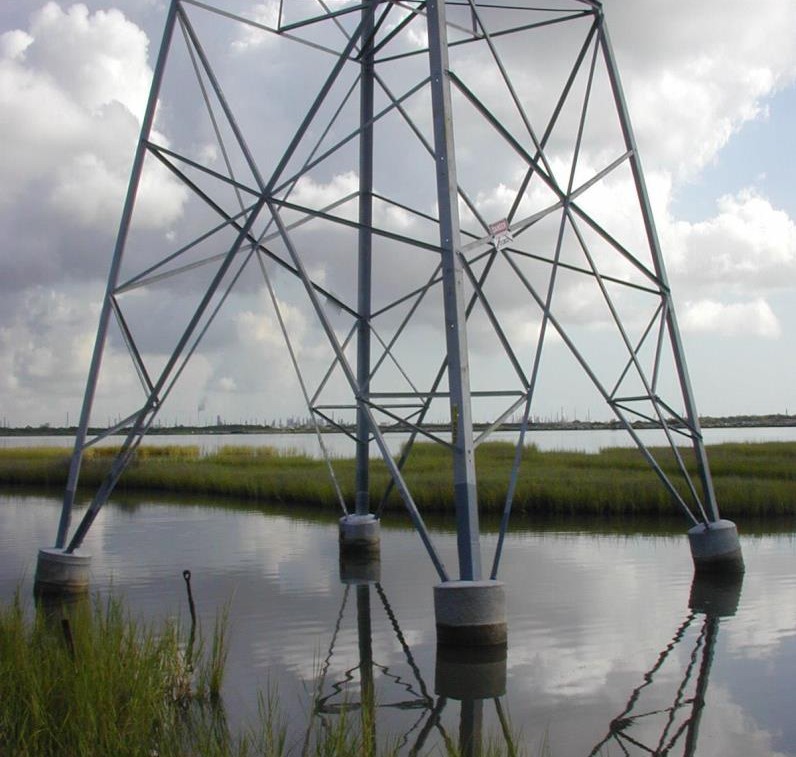
| Owner | Reliant Energy (Houston Lighting & Power), Texas, USA |
|---|---|
| Site | Galveston Bay, on the Gulf of Mexico |
| Asset | Legs of transmission towers, from a network of more than 8,000 towers |
| Installed | Winter 1999 to 2000 |
| Product | Si-COAT 579 CM, grey |
| Exposure | Tidal sea water up to about 1.2 m deep, splash, salt fog and strong UV |
One of the harshest tower sites in the USA
Galveston Bay is notorious for salt fog. Reliant Energy ran more than 8,000 transmission towers there, and most of them stood in swampland. When the tide came in from the Gulf of Mexico, sea water flooded the towers up to about 1.2 m (4 ft) deep.
The water was only part of it. Wash from recreational boats threw salt spray onto the legs just above the waterline. Then, as the tide went out, pools stayed behind and evaporated in the Texas sun, so the salt got stronger. Together with constant salt fog off the Gulf, this made the bay one of the most corrosive places in the country. In fact, even bare galvanised steel there started corroding within four months.
Why earlier transmission tower coatings failed
Reliant had tried conventional “high performance” coatings based on epoxy and alkyd. However, they didn’t last, so crews kept redoing the same legs and the maintenance budget kept running over. On top of that, the epoxy mastics had to go on by hand, and the maintenance crews reported health problems from working with them.
For years, the utility’s superintendent of tower maintenance treated this as the cost of working in the bay. Then Reliant came across Si-COAT 579 CM and decided to test it.
Testing Si-COAT 579 CM on the tower legs
According to CSL, the results came quickly. The crews found 579 CM the simplest product they had worked with, and the health complaints from the mastics stopped. So Reliant set out to coat every tower leg in the bay that needed urgent attention.
How the crew applied the transmission tower coating
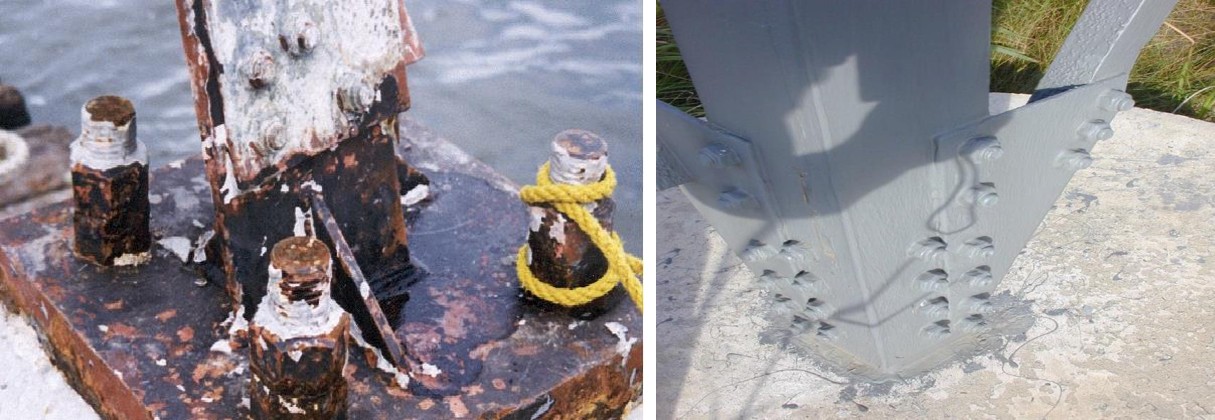
Preparation was basic. First, the crew took off loose rust and dirt with a wire brush. Next, they wiped the legs down with a rag soaked in solvent. After that, they brushed on 579 CM to a dry film of about 0.38 mm (15 mil, 380 microns).
That simple routine made the difference on a swamp site. Because there was no blasting, nobody needed to bring compressors, abrasive or containment out to towers standing in water. For more on how far you can go without blasting, see our surface tolerant coating guide.
Results after three years
With so little preparation and an easy product, the project came in under budget. Equally important, jobs that used to take four months now took six weeks.
After more than 36 months in service, CSL reports that the coating still looked as new as the day it went on. It also showed no sign of wear or weathering. Of course, three years is a short time for a tower. For a longer record of 579 CM, look at the Florida power plant piping, where CSL found no loss of film thickness after about 20 years.
From tower legs to whole towers and their bases
Reliant then decided to coat whole towers with 579 CM over the following years, not only the legs. It also chose to coat the concrete bases with the same product.
That matches what TSS does in the field. On concrete plinths, we carry one continuous coat from the concrete straight onto the steel. Before that, the laitance and any wax or resin curing compound must come off, because 579 CM will not bond over them.
Transmission tower coating for Southern African grids
Southern Africa has its own Galveston Bays. Lines along the KwaZulu-Natal and Western Cape coasts sit in salt fog, while lines near Walvis Bay and Maputo face the same mix of salt and sun. Inland, mines and industry add dust and chemical fallout. Our article on transmission tower corrosion explains why this matters for the grid.
For these lines, a transmission tower coating that goes on by brush over wire brushed steel suits the way maintenance crews already work. Similarly, on the same towers, Si-COAT 570 HS insulator coating deals with pollution flashover on the insulators. So one supplier covers both the steel and the insulators.
What this job shows, and what it doesn’t
This is CSL’s published result from a tidal site, and we quote it as CSL gives it. Here, the legs saw intermittent flooding and splash, not permanent immersion. For steel that stays under water all the time, specify a lining system rated for immersion. Also, where a site needs a rated system for C5 High conditions, use the Si-COAT CM System with CSL 979 primer.
Transmission tower coating FAQ
Can you apply a transmission tower coating by brush?
Yes. At Galveston Bay, the crews brushed 579 CM onto the tower legs to about 0.38 mm (15 mil) dry. Spray and roller work too, so you can choose what suits the site.
Does galvanised tower steel need blasting before coating?
No. In Galveston Bay, the crew used a wire brush and a solvent wipe. In general, 579 CM goes onto steel cleaned to SSPC SP2 or SP3, or water jetted to SSPC SP12 WJ-4. Loose rust and flaking paint must still come off.
Can 579 CM go onto the concrete bases too?
Yes. Reliant chose to coat its concrete bases as well. TSS carries one continuous coat from the plinth onto the steel, after removing laitance and any curing compound.
Where can I get Si-COAT 579 CM in Southern Africa?
Technical Solution Supplies distributes CSL Silicones products across Southern Africa, including the DRC and the Seychelles. For data sheets, samples and pricing, request a quote with photos of your towers.
More corrosion case studies and articles
- First, the silicone corrosion coating product page and the 579 CM FAQ.
- Also, the Florida Power & Light fuel tank, another utility job.
- Next, the Florida Fence Test results for 579 CM.
- Finally, all our case studies in one place.
Proud exclusive distributor of CSL Silicones in Southern Africa.
Send us the problem
Photos and a rough size are enough to start, while drawings and specs can follow later. Then we come back with the right product and a quote.