Intake Screen Coating: Florida Power Plant Case Study
An intake screen coating at a coastal power plant has to cope with sea water, splash, sun and marine growth. In January 2003, Florida’s largest power utility had new travelling screens coated with one coat of Si-COAT 579 CM after its epoxy system failed within three years.
| Owner | The largest power utility in Florida, USA |
|---|---|
| Sites | Cooling water intakes at coastal power plants, Atlantic and Gulf coasts |
| Asset | New travelling screens, hot dip galvanised steel frames |
| Installed | January 2003 |
| Product | Si-COAT 579 CM, galvanic metallic colour |
| Exposure | Sea water, wave splash, strong UV and marine growth |
Why power plants need intake screens
This utility runs many power plants along Florida’s Atlantic and Gulf coasts. One reason they sit on the coast is cooling water, which they draw straight from the sea. However, the sea brings debris with it. Over the years, the intakes have pulled in wood, shark carcasses and even old cars, and any of that can wreck plant machinery.
So the utility fits screens at the mouth of each large intake pipe. The mesh is stainless steel, while the frames use galvanised steel. To keep the mesh clear, the screens travel. Every so often, the mesh rotates on a closed loop, which brings a clean section into place and dumps the debris it caught.
Why the old intake screen coating failed
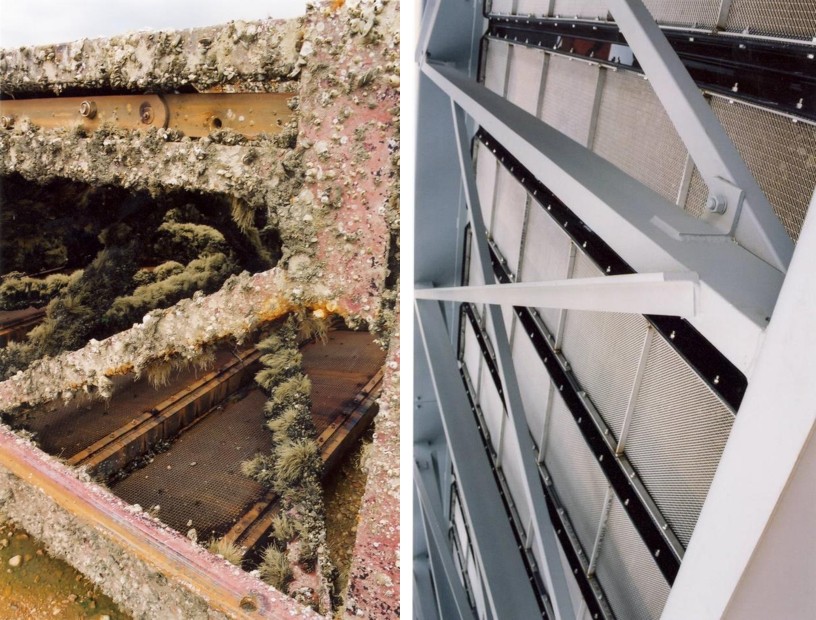
The frames originally carried a multi layer epoxy system on top of the galvanising. In theory, self cleaning screens should need little maintenance. In practice, the epoxy was chalking, peeling and blistering within about three years, with heavy corrosion creeping under it.
The splash zone was worst. There, salt spray dried in the sun and left stronger salt behind on the steel. On top of that, the epoxy made an ideal home for marine life. Barnacles, mussels, algae and urchins grew on the frames until they jammed the rotating mesh.
Why the engineer chose Si-COAT 579 CM
The utility’s lead corrosion engineer already knew 579 CM well. It had come out on top in the utility’s own three year Florida Fence Test. So when he ordered new screens, he specified 579 CM on the frames.
He also expected it to deal with the marine growth. According to CSL, 579 CM has a very low surface tension, so it acts as a non stick surface. That gave marine life far less to grip than the old epoxy.
Applying the intake screen coating in the factory
Screening Systems International of Slaughter, Louisiana, built the new screens and coated them in its own factory. Because the steel was new, the maker first hot dip galvanised it as an extra safeguard.
Next, the coater wiped the galvanising down with acetone to SSPC SP1, which removed the oily residue that galvanising leaves behind. After that, factory air at about 8 bar (120 psi) blew off any loose flakes of zinc. Then the coater sprayed one coat of 579 CM to about 0.3 mm (12 mil, 305 microns) dry. The rig was a Graco 80:1 airless pump with an inline filter and tips of 0.017 to 0.019 inch.
Finally, the coater force cured the coating for two hours at 60°C (140°F), so the frames could move around the factory. After that, it cured fully overnight at room temperature.
Results on the screens
CSL reports a clear result for the utility. Marine life could no longer hold on to the coated frames, so it stopped interfering with the screens. Meanwhile, the corrosion protection outperformed anything the utility had used before. As a result, the utility now specifies 579 CM on all its new screens.
Intake screen coating for Southern African plants
Southern Africa also draws cooling and process water from the sea. Coastal power stations, refineries, harbour pump stations and desalination plants on the Namibian coast all run intakes. As in Florida, their screens and frames sit in splash, salt and marine growth.
For new screens, this job shows a simple route: galvanise the steel, then shop apply one coat of 579 CM. For older frames, the Florida Power & Light fuel tank and the Florida power plant piping show 579 CM going on over prepared rust instead. Also, our Durban harbour hopper shows it on local marine steel.
What this job shows, and what it doesn’t
This is CSL’s published result on these screens, and we quote it as CSL gives it. We don’t offer 579 CM as a general immersion coating or a hull antifouling. So if you have intake screens or other steel that sits in sea water, send us the details and we’ll check the job with CSL first.
Intake screen coating FAQ
Does marine growth stick to Si-COAT 579 CM?
On these Florida screens, CSL reports that marine life could no longer hold on to the coating. That comes from the very low surface tension of the silicone. Still, results depend on the site, so ask us before you specify it for marine growth.
Can 579 CM go over new galvanised steel?
Yes. On these screens, the coater cleaned the new galvanising with acetone to SSPC SP1, blew off loose zinc, and sprayed one coat. In short, the key step is removing the oily film from the galvanising process.
Can you apply the intake screen coating in a factory?
Yes. Here, the screen maker sprayed 579 CM in its own shop and force cured it for two hours at 60°C, so it could handle the frames the same day.
Where can I get Si-COAT 579 CM in Southern Africa?
Technical Solution Supplies distributes CSL Silicones products across Southern Africa, including the DRC and the Seychelles. For data sheets, samples and pricing, request a quote with photos of your screens.
More corrosion case studies and articles
- First, the silicone corrosion coating product page and the 579 CM FAQ.
- Also, the Reliant Energy towers in Galveston Bay, another tidal site.
- Next, our corrosion protection in Namibia article for coastal conditions.
- Finally, all our case studies in one place.
Proud exclusive distributor of CSL Silicones in Southern Africa.
Send us the problem
Photos and a rough size are enough to start, while drawings and specs can follow later. Then we come back with the right product and a quote.