Substation Corrosion Protection: Dungeness Field Trial
Substation corrosion protection on the coast has to stop rust without long outages for blasting and priming. In June 2020, Si-COAT 579 CM went onto two rusted test areas at a 400 kV substation at Dungeness, on the south east coast of England, as a field trial.
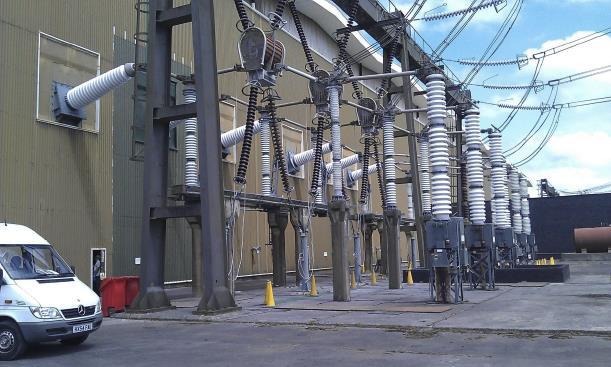
| Site | 400 kV substation at Dungeness Power Station, south east England |
|---|---|
| Test areas | A section of roller shutter door on the north side, and a section of gutter on the south side facing the sea |
| Installed | June 2020 |
| Product | Si-COAT 579 CM, white |
| Exposure | Sea air, salt and rain |
| Status | Field trial. CSL has not yet published the inspection result |
Why this substation needed better corrosion protection
Dungeness sits on a shingle headland right on the English Channel. So the painted metalwork at the substation lives in wet, salty air all year round. At the time of the trial, the existing paint was a traditional corrosion maintenance system, last maintained an estimated ten or more years earlier.
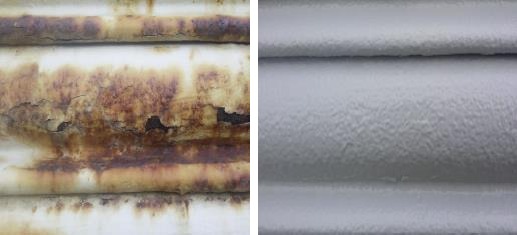
By then, UV had weakened that paint, and movement or knocks had cracked it in places. As a result, moisture and oxygen got through to the steel, and rust followed. The roller doors and gutters in the photos show how far it had gone.
The problem with a conventional repaint
Traditional systems can last more than ten years. However, doing them properly again usually means taking off all the rust and old paint, profiling the steel and priming before the topcoat. On a live substation, that means long disruption and high labour costs. So the site needed a cheaper, longer lasting way to extend the life of steel that was already rusting.
Applying the substation corrosion protection trial
The trial used two test areas. One was part of a roller shutter door on the north side of the substation. Another was a section of gutter on the south side, which faces the sea.
Preparation stayed simple. First, the crew scraped and wire brushed off loose rust and paint. Next, they wiped the surfaces with a cloth soaked in solvent to remove greasy residue. Then they applied 579 CM by air assisted spray, to CSL’s specification. There was no blasting, no profiling and no separate primer.
Where the trial stands
CSL reports that the application went well, and it expects good results on this heavily corroded steel. The plan was for CCS to inspect the test areas after one year, checking their condition and looking for rust creep.
However, CSL’s case history doesn’t include that inspection result. So we can’t tell you how the trial turned out, and we won’t guess. Once CSL sends us the result, we’ll add it to this page. Until then, treat this as a record of the method, not a proven result.
For results with an ending, look at our other case studies. On process piping at a Florida power plant, CSL found no loss of film thickness after about 20 years. Similarly, at Reliant Energy’s transmission towers, the coating still looked new after three years in a tidal swamp.
Substation corrosion protection in Southern Africa
Coastal substations in KwaZulu-Natal, the Eastern Cape and the Western Cape face the same sea air. Inland, mines and industry add dust and chemical fallout. In both cases, the rust usually shows first on the small things, such as roller doors, gutters, cable trays, kiosks and steel gantries.
Because 579 CM goes on over wire brushed steel with no blasting, crews can treat these items without long outages. Meanwhile, on the same sites, Si-COAT 570 HS insulator coating deals with pollution flashover. It passed both IEC TR 62730 tests, as our test results page explains. So one supplier covers the steel and the insulators.
What CSL says about Si-COAT 579 CM
In the case history, CSL describes 579 CM as a one part, moisture curing RTV silicone for above ground steel in retrofit work. It goes on in one coat and primes itself. According to CSL, all colours withstand 5,000 hours of accelerated weathering (QUV) with a colour change of about 1 delta E. Also, it stays elastic, so it moves with the steel as it heats and cools.
Substation corrosion protection FAQ
Does substation corrosion protection need blasting?
No. At Dungeness, the crew used scrapers, wire brushes and a solvent wipe. In general, 579 CM goes onto steel cleaned to SSPC SP2 or SP3, or water jetted to SSPC SP12 WJ-4. Loose rust and flaking paint must still come off.
Did the Dungeness trial work?
CSL reports that the application went well, but its case history doesn’t include the one year inspection result. We’ll add it here once CSL sends it.
What does substation corrosion protection with 579 CM cover?
It covers above ground steel, such as roller doors, gutters, cable trays, kiosks, gantries and structures. However, it is not for buried steel, immersion or tank linings. For C5 High sites, use the Si-COAT CM System with CSL 979 primer.
Where can I get Si-COAT 579 CM in Southern Africa?
Technical Solution Supplies distributes CSL Silicones products across Southern Africa, including the DRC and the Seychelles. For data sheets, samples and pricing, request a quote with photos of your substation steel.
More corrosion case studies and articles
- First, the silicone corrosion coating product page and the 579 CM FAQ.
- Also, the air core reactors at a 500 kV substation, recoated with Si-COAT 570 HS.
- Next, our surface tolerant coating guide on preparation without blasting.
- Finally, all our case studies in one place.
Proud exclusive distributor of CSL Silicones in Southern Africa.
Send us the problem
Photos and a rough size are enough to start, while drawings and specs can follow later. Then we come back with the right product and a quote.