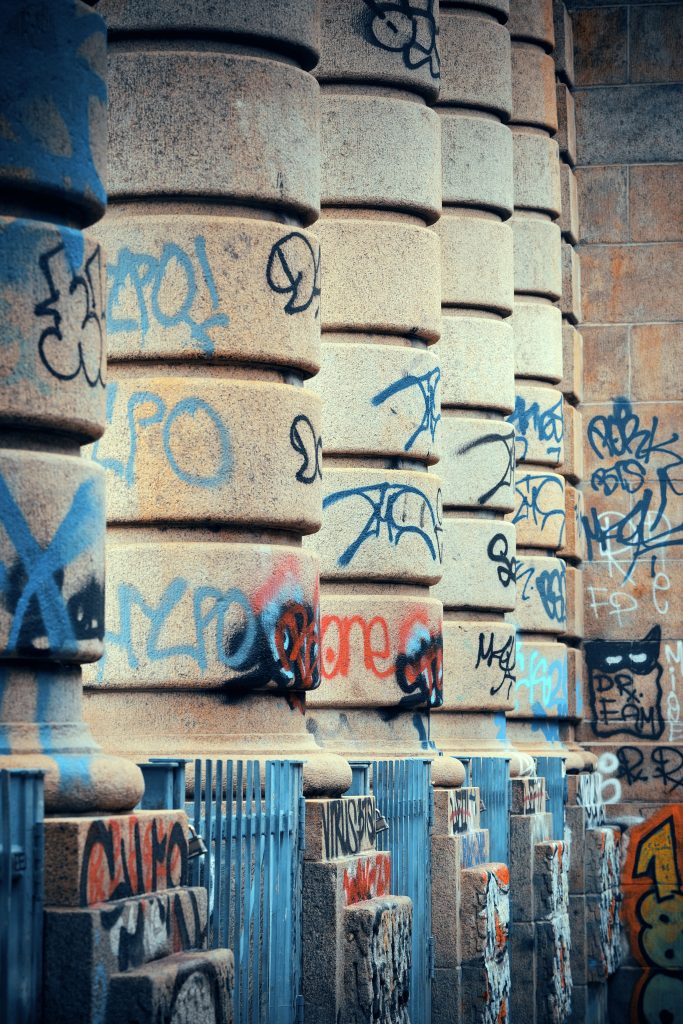
This anti graffiti coating FAQ answers the questions property managers, municipalities and facility owners ask most often. The first part covers Si-COAT 531AG Clear, the permanent clear coating made by CSL Silicones. After that, we answer general questions about graffiti protection in South Africa. Also, for real projects, see our anti graffiti case studies.
Si-COAT 531AG Anti Graffiti Coating FAQ
What is Si-COAT 531AG Clear?
Si-COAT 531AG Clear is a single component, room temperature vulcanising (RTV) polysiloxane coating that cures with moisture from the air. It is clear with a semi gloss finish, and it is permanent, not sacrificial. Because it bonds chemically to the host surface, it stays in place through repeated graffiti removal.
How do you remove graffiti from Si-COAT 531AG?
Remove graffiti as soon as possible with a cold water pressure washer at about 83 bar (1,200 psi). Use a wide fan tip, never a zero degree or turbo nozzle, and keep it moving. You need no solvents, because the water repellent film stops paint soaking in. As a result, nothing harsh runs off into stormwater drains.
What if graffiti stays on for more than 10 days?
Older graffiti can resist cold water. In that case, switch to a warm water pressure wash. Specialty paints with adhesion primers can hold on in rare cases. For those, apply a biodegradable surfactant such as dish soap with a cleaning pad, then rinse straight away. However, always test any cleaner on a small, hidden patch first.
Is Si-COAT 531AG permanent or sacrificial?
It is permanent and non sacrificial. Unlike a sacrificial coating, it does not wash off with the graffiti. Therefore, you do not recoat after every clean.
What surfaces can it protect?
CSL lists metal, concrete, brick, stone, wood, fibreglass and existing coatings as suitable surfaces. For example, that covers retaining walls, bridges, train carriages, shopfronts and electrical kiosks. Bridges often need steel protection as well, as our article on bridge corrosion protection explains.
Does it need a primer?
Most common surfaces need no primer. Still, CSL recommends a quick field adhesion test before you start.
Does it need abrasive blasting?
No. The coating bonds chemically, so blasting is not necessary. Instead, the surface must be clean and dry, free of dirt, chalking paint, loose rust, mill scale, grease, oil, curing compounds and laitance.
How long does it take to cure?
At 25°C and 50% humidity, it skins in 20 to 30 minutes and is tack free in 60 to 90 minutes. Then it cures through in 4 to 6 hours. Finally, full physical properties develop over 7 days.
How much coverage do you get?
Apply at 0.15 to 0.25 mm dry film thickness (6 to 10 mil, 152 to 254 microns). That works out to about 0.22 to 0.36 litres per square metre, before losses. In other words, one litre covers about 2.8 to 4.6 m² in theory. Volume solids are 70%. Also, porous surfaces take more, so allow a loss factor.
What temperatures can it handle?
In service, the cured coating is stable from minus 60°C to 200°C continuous. During application, however, air and surface must sit between 5°C and 60°C and at least 3°C above the dew point. Otherwise, condensation can leave a matte finish.
Will the coating change the look of the surface?
The colour underneath shows through, because the coating is clear. However, it dries to a semi gloss sheen. So try a small test patch first, especially on matte surfaces such as face brick or stone. Airless spray also gives a better finish than brush or roller.
How do you apply it?
First, mix it with a powered agitator at 300 to 400 rpm for at least 5 minutes. Airless spray is the recommended method, although brush or roller suits small areas. Note that brush and roller need more than one coat to reach 0.15 mm (6 mil) dry film thickness. CSL also intends it for professional applicators only.
What is the shelf life?
Shelf life is 12 months from the date of manufacture, in the original unopened container below 32°C. After that, the product needs inspection again. Store it in dry, shaded conditions, away from heat.
Is there a coloured version?
Yes. Si-COAT 528AG is the pigmented version, and TSS still supplies it. However, we lead with 531AG Clear, because it goes over any colour and keeps the original look.
General Anti Graffiti Coating FAQ
What is anti graffiti coating?
Anti graffiti coating is a protective layer that stops paint, ink and marker from bonding permanently to a surface. There are two types: sacrificial and permanent. Each one, however, behaves differently when you clean it.
What is the difference between permanent and sacrificial coatings?
A sacrificial coating washes off with the graffiti, so it has to go back on after every clean. A permanent coating, by contrast, stays bonded to the surface. As a result, the choice drives long term maintenance cost.
Does anti graffiti coating actually work?
Yes, if the system suits the job. For example, a permanent coating such as Si-COAT 531AG allows repeated cleaning without reapplying. Still, results depend on good surface preparation and removing graffiti early.
How do you remove graffiti without a protective coating?
Unprotected surfaces usually need solvents, abrasive blasting or repainting. Moreover, these methods often damage the substrate, and porous surfaces can keep a ghost of the tag. In addition, the cost comes back every time the graffiti does. Our article on graffiti removal in South Africa looks at this in more detail.
Is graffiti illegal in South Africa?
Yes. Graffiti counts as malicious damage to property, a criminal offence. Even so, enforcement is difficult across large networks, which is why physical protection matters.
Why do municipalities and rail operators need protection?
They manage huge areas of walls, bridges, stations and carriages. Because vandals tag the same surfaces again and again, removal costs keep coming back. A permanent coating therefore cuts the repeat cost of every clean. For a local example, see our article on graffiti removal costs in Cape Town.
Can anti graffiti coating protect heritage buildings?
It can, because the coating suits stone, brick and masonry. However, the semi gloss sheen may change how a matte surface looks, so always do a test patch. Also, buildings older than 60 years fall under the National Heritage Resources Act. So check with the provincial heritage authority before coating one.
Buying and Technical Support
Where can I buy it in South Africa?
Technical Solution Supplies distributes CSL Silicones products across Southern Africa, including the DRC and the Seychelles. We also give technical support and application guidance on every project. For more, see our anti graffiti coating article or the full product FAQ.
If this anti graffiti coating FAQ does not answer your question, contact us and we will help with specifications and coverage for your site.
Proud exclusive distributor of CSL Silicones in Southern Africa.