Surface Tolerant Coating on a Crude Oil Tank: Hellenic Petroleum
Si-COAT 579 CM is a surface tolerant coating, and this Hellenic Petroleum job shows what that means in practice. In 2004, CSL Silicones recoated a 6,000 m² crude oil tank near Athens with no abrasive blasting, using six people in twelve days.
| Location | Athens, Greece, about 300 m from the sea |
|---|---|
| Owner | Hellenic Petroleum |
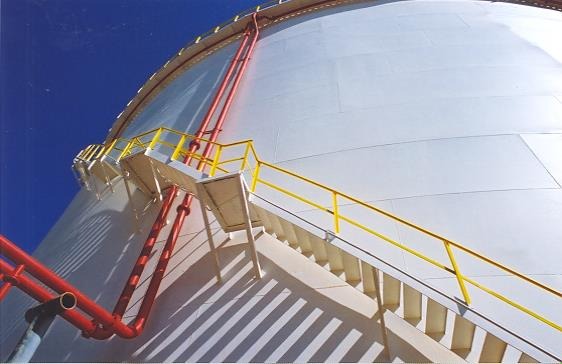
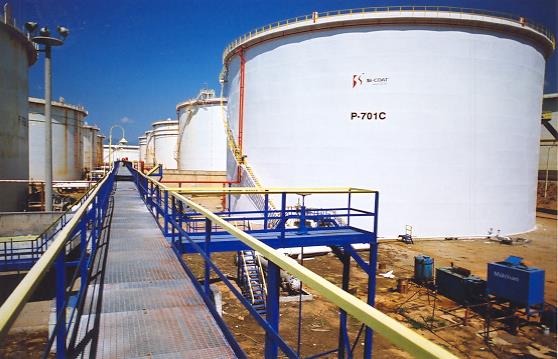
| Asset | Crude oil tank P-701C, 43 m across and 23 m high |
| Area | 6,000 m², including the floating roof exterior |
| Prep | 800 bar water wash, no abrasive blasting |
| Product | Si-COAT 579 CM, one coat at 0.35 mm dry |
| Applied | 2004, by six people in 12 days |
When epoxy fails at the coast
Hellenic Petroleum runs a tank farm on the outskirts of Athens, only 300 metres from the sea. Overall, the farm holds 16 tanks, with a combined crude oil capacity of 1.2 million cubic metres. So close to the water, salt contamination and rust are a constant battle.
In 1997, HP applied a three coat epoxy system to the tanks. Despite correct application, pinhole rusting showed up within six months. Still, HP accepted this as the best any system it had tried could do, and planned a seven year recoating cycle. Then, by the end of that cycle, the tanks had heavy pitting and widespread rust staining, with rust blisters about 300 mm across.
Epoxy brought a second problem too. Abrasive blasting, the standard prep for recoating, sent blast media drifting into nearby homes. As a result, people living within a kilometre of the farm objected strongly to the dust and its health effects. HP had to look after its tanks without harming its neighbours, while also keeping costs under control.
A surface tolerant coating instead of blasting
This is where a surface tolerant coating changes things. Epoxy needs a blasted surface profile to bond to steel, whereas Si-COAT 579 CM bonds to rusted steel and sound old coatings without blasting. You still have to remove oil, grease, salts, loose rust and flaking paint. On this tank, for example, an 800 bar water wash did that job.
For HP, therefore, that meant no blast media drifting into the community, no hot work and no long shutdown. CSL Silicones first introduced Si-COAT 579 CM to HP in 2000. Over nearly four years, HP then tested it on small patches across the farm. Eventually, those results gave it the confidence to commit to a full tank.
The project: tank P-701C, Athens, 2004
In 2004, HP awarded the first big job to CSL Silicones. Specifically, it picked tank P-701C, which was both the tank in the worst condition and the most visible from outside the farm.
The tank is 43 metres across and 23 metres high. Including the outside of the floating roof, the total area came to 6,000 m². CSL then brought in Mühlhan Hellas S.A. to do the fieldwork under direct CSL supervision, using its high pressure water blasting equipment.
Even though the steel was in bad shape, prep took only a pressure wash at 800 bar (11,600 psi). On average, the crew coated each area a day after washing it. Then they applied Si-COAT 579 CM in one coat at 0.35 mm dry (350 microns, about 14 mil), using 3,200 kg of product in total.
Surface tolerant coating results: 720 hours vs 6,720 hours
Overall, the job took 12 days with a crew of six. By comparison, a conventional system on the same tank would have needed 16 people for 42 days. In working hours, that is 720 hours with Si-COAT 579 CM against 6,720 with the conventional route, about 89% fewer.
| Conventional system | Si-COAT 579 CM | |
|---|---|---|
| Crew | 16 people | 6 people |
| Duration | 42 days | 12 days |
| Working hours | 6,720 | 720 |
| Abrasive blasting | Yes | No |
| Coats | Multi coat system | One coat |
The tank also went back into service much sooner, and the neighbours had no blast media to deal with. After this result, HP began looking at Si-COAT 579 CM for the other tanks on the farm and for its main site at Aspropyrgos.
Surface tolerant coating for Southern African tanks
In short, the conditions at Athens were salt air, strong UV, wide temperature swings and homes nearby. Similarly, coastal plants in South Africa, Namibia and Mozambique face the same corrosion drivers. Likewise, tank farms, refineries and fuel terminals near towns face the same pressure over abrasive blasting.
So Si-COAT 579 CM gives Southern African sites the same performance, without the prep burden of conventional systems. For more on tanks, read our article on silicone coating for petroleum tanks. For full product details, see our silicone corrosion coating page and the Florida Fence Test results. Closer to home, the same coating also protects a hopper in Durban harbour and process tanks at a chlorine plant in Johannesburg.
Frequently asked questions about surface tolerant coating
What is a surface tolerant coating?
It is a protective coating that bonds to steel without abrasive blasting. Epoxy systems need a blasted surface profile to stick, whereas a surface tolerant coating gets its grip from its own chemistry. Si-COAT 579 CM is a single component RTV silicone that bonds to rusted steel, tightly bound rust and sound existing coatings. So it suits maintenance work where blasting is impractical, restricted or too costly. Our surface preparation guide explains the prep in detail.
Why does epoxy fail at the coast?
Epoxy is vulnerable to moisture getting in, salt contamination and UV over time. At the coast, salty air drives corrosion under the film, which leads to pinhole rusting, blistering and peeling. At Hellenic Petroleum, the three coat epoxy showed pinhole rusting within six months, despite correct application. Si-COAT 579 CM, by contrast, resists salt fog, UV and the temperature swings that break down conventional coatings.
Can Si-COAT 579 CM go over corroded steel without blasting?
Yes. CSL made 579 CM for corrosion maintenance on steel that is already deteriorating. Prep is hand or power tool cleaning (SSPC SP2 or SP3) or water jetting (SSPC SP12, WJ-4) to remove oil, grease, salts and loose material. The coating then bonds to the prepared surface, including tightly bonded old coating and bare metal. Hellenic Petroleum proved this on a tank with heavy pitting and rust blisters.
How much labour does 579 CM save?
Hellenic Petroleum gives a documented reference. Coating 6,000 m² of tank with Si-COAT 579 CM took 720 working hours, a crew of six over 12 days. A conventional system would have needed about 6,720 hours, or 16 people over 42 days. That is a labour saving of about 89%, mainly because there is no blasting and only one coat.
Is Si-COAT 579 CM available in Southern Africa?
Yes. Technical Solution Supplies distributes CSL Silicones products across Southern Africa, including the DRC and the Seychelles. To discuss your tank or plant, request a quote.
More corrosion protection articles
- Corrosion Coating Cost: How to Compare Quotes on Total Cost of Ownership

- Corrosion Protection in South Africa: Comparing the Methods That Actually Work

- Corrosion Protection Coating South Africa: Everything You Need to Know
- Corrosion Resistant Coating for Mining: Protecting Copper Operations Across Southern Africa
- Mining Corrosion Protection in South Africa: Why SI-COAT 579 CM Outperforms Traditional Coatings

- Anti-Corrosion Coating for Structural Steel: Why Silicone Outperforms Epoxy


Send us the problem
Photos and a rough size are enough to start, while drawings and specs can follow later. Then we come back with the right product and a quote.