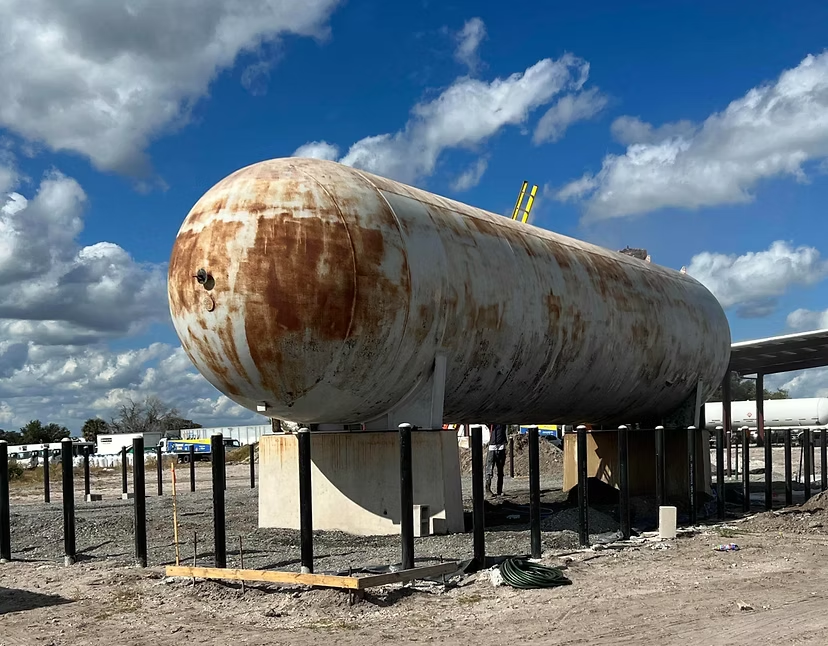

After
images credit to Premier Coatings Solutions.
South Africa’s climate punishes exposed steel. Coastal salt spray corrodes structures in Durban and Cape Town. Inland UV exposure bakes coatings in the Karoo. Sudden storms in Gauteng add moisture cycles that accelerate rust. A reliable corrosion maintenance coating needs to withstand all three challenges at once. SI-COAT 579 CM does exactly that, using a single-component silicone chemistry built for long-term steel protection.
Built to Resist South Africa’s Weather
SI-COAT 579 CM forms a flexible, breathable barrier over steel. Therefore, it resists salt spray, humidity, and extreme temperature swings without cracking. CSL Silicones tested every colour to 5,000 hours of accelerated UV weathering. As a result, the coating maintains its protective properties even under constant sun exposure. The elastomeric formulation flexes with the substrate, so thermal cycling does not compromise the film.
Corrosion Maintenance Coating for Mining and Industrial Sites
Mining and processing operations expose steel to sulphuric acid, aggressive dust, and constant chemical contact. SI-COAT 579 CM resists these conditions without a primer coat. Surface preparation only requires SSPC-SP1 solvent cleaning or SSPC-SP3 wire brush and power tool cleaning. Consequently, maintenance teams skip abrasive blasting entirely, even on tightly bound rust and existing coatings. This surface-tolerant approach saves time on structures where access stays limited, such as tanks, pipelines, and processing equipment.
Fast, Simple Application With Long-Term Results
Contractors apply SI-COAT 579 CM as a single coat at 9 to 14 mils dry film thickness. The single-component RTV silicone system needs no mixing, no primer, and no intermediate layers. As a result, application crews finish 70 to 80 percent faster than with traditional three-coat epoxy systems. Applicators can spray, brush, or roll the coating between 5 and 60 degrees Celsius ambient temperature. However, SI-COAT 579 CM does not suit continuous liquid submersion. Projects needing full immersion protection should specify an ISO 12944-9 Im2 or Im3 rated system instead.
Documented Performance in Harsh Environments
CSL Silicones designed SI-COAT 579 CM for demanding industrial environments, and independent testing backs the claims. Accelerated saltwater immersion testing equivalent to NASA standards showed zero corrosion creep. Adhesion failure did not occur even after three years of continuous exposure. Furthermore, documented service life exceeds 30 years in harsh mining and industrial settings. TSS supplies SI-COAT 579 CM across South Africa, Zambia, DRC, Tanzania, and Namibia. TSS holds the exclusive Sub-Saharan Africa distributorship for CSL Silicones.
Frequently Asked Questions
Does SI-COAT 579 CM require sandblasting before application?
No. SI-COAT 579 CM only needs SSPC-SP1 solvent cleaning or SSPC-SP3 wire brush and power tool cleaning. The coating bonds directly to tightly bound rust and existing coatings, so abrasive blasting is not necessary.
How long does SI-COAT 579 CM last in mining environments?
CSL Silicones has documented a service life of 30 years or more in harsh mining and industrial conditions. Independent saltwater immersion testing also confirmed zero corrosion creep after three years of continuous exposure.
Can SI-COAT 579 CM handle sulphuric acid exposure?
Yes. The coating resists sulphuric acid, salt spray, and other acidic process chemicals common in copper and mineral processing. This chemical resistance makes it suitable for tanks, pipelines, and structural steel in acid-exposed areas.
Is SI-COAT 579 CM suitable for submerged applications?
No. SI-COAT 579 CM does not suit continuous liquid submersion. Projects requiring full immersion protection should specify a coating system rated to ISO 12944-9 Im2 or Im3 instead.
What temperature range suits application of SI-COAT 579 CM?
Applicators can apply SI-COAT 579 CM between 5 and 60 degrees Celsius ambient temperature. This wide range suits most South African conditions across coastal, inland, and highveld regions.
To discuss SI-COAT 579 CM for your corrosion maintenance needs, visit our corrosion protection category page , contact us through our contact us page or visit our FAQ page for more information. Proud distributors of CSL Silicones.
Hi,
I’m currently searching for an alternative to hot dipped galvanizing for our prop range, ideally the props to be dipped to coat internal and external surfaces including adjustment nuts and threads, it must also be resistant to the wear on the threads and adjustment nut, would SI-COAT 579 CM suit this application?
Good Day Gavin,
Thank you for reaching out to us, Silicone dipping is absolutely a viable option for props, and it brings several meaningful advantages. The coating offers strong chemical resistance, excellent hydrophobic properties and a consistent, attractive finish when applied by dip. Because it’s a high-solids formulation, it releases cleanly from threads, doesn’t become gummy and doesn’t interfere with adjustment mechanisms. Another practical benefit is that if the coating is damaged through normal handling, it can be touched up or repaired easily on-site without needing to redo the entire prop.
It’s important to note that silicone works as a barrier coating and doesn’t provide the sacrificial protection associated with zinc. That said, it performs very well in environments where chemical resistance, surface cleanability and easy maintenance are key priorities. Many clients use it either as a standalone barrier in moderate-wear conditions or as an added top layer over existing zinc systems to enhance overall performance.
A practical next step is an on-site test. Applying the coating to a small batch of props under real working conditions provides clear, direct feedback on performance. It also gives us the opportunity to visit, assess the environment and ensure the coating is matched correctly to their application. This approach keeps everything evidence-based and gives you the client confidence in the outcome.
Please let us know if a onsite meeting at your establishment is possible to discuss further.