For municipalities, property owners and facility managers, graffiti removal South Africa wide has become a costly, endless job. Vandals tag a wall, a crew cleans it, and the tags often return within weeks. Each clean uses harsh chemicals and paid labour. However, there is a better way, and it starts before the graffiti lands.
Si-COAT 531AG Clear is a permanent anti graffiti coating made by CSL Silicones. It bonds chemically to the surface, so most tags wash off with a cold water pressure washer and no solvents. Because it is clear, it goes over any colour. We also supply Si-COAT 528AG, the pigmented version, for jobs that need a colour.
Graffiti Removal South Africa: The Real Cost
Graffiti is more than an eyesore. For anyone who manages large surface areas, it is a repeat operating cost. Crews return after every incident, chemicals run out and need buying again, and someone has to coordinate it all across several sites. Meanwhile, the walls themselves take a beating from each round of cleaning.
The scale is real. For example, in 2021/22 the City of Cape Town’s graffiti teams removed more than 31,000 m² of illegal graffiti in 130 operations. Without protection, much of that surface faces the same job again. Our article on graffiti removal costs in Cape Town looks at the cost side in more detail.
Why Chemical Removal Falls Short
Chemical removers break down the paint so crews can wash or wipe it off. On bare concrete, brick or painted masonry, however, the result is rarely clean. Paint soaks into porous surfaces, so a faint ghost of the tag often stays behind. In addition, repeated solvent and abrasive cleaning wears the surface, which can leave it more open to the next tag.
Over time, the wall ends up stained, patchy or due for repainting. As a result, owners pay for remediation on top of the removal itself. Sacrificial coatings help a little, but they wash off with the graffiti. Therefore, they must go back on after every clean, and the repeat cost stays.
How a Permanent Coating Changes Graffiti Removal
Si-COAT 531AG is a single component, room temperature vulcanising (RTV) polysiloxane coating that cures with moisture from the air. Unlike a sacrificial product, it is permanent and non sacrificial. It bonds chemically to the host surface and stays in place through repeated cleaning.
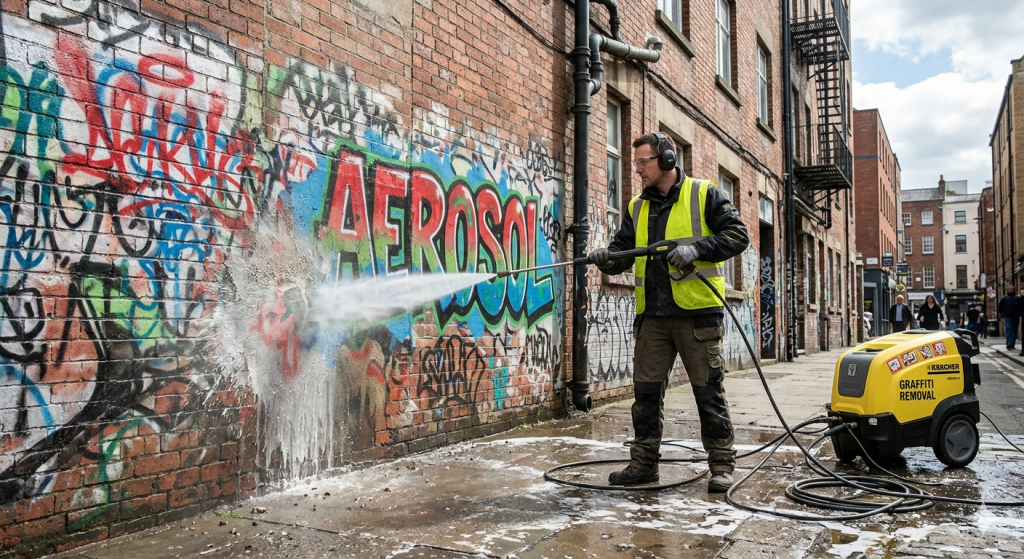
Because the cured film is water repellent, paint sits on top of it rather than soaking in. So a cold water pressure wash at about 83 bar (1,200 psi) lifts most graffiti off. If a tag has stayed on for more than 10 days, switch to warm water. In rare cases, specialty paints with adhesion primers may still hold. For those, use a biodegradable surfactant such as dish soap with a cleaning pad, then rinse straight away.
CSL lists metal, concrete, brick, stone, wood, fibreglass and existing coatings as suitable surfaces. Most need no primer and no abrasive blasting, although CSL recommends a quick field adhesion test first.
Graffiti Removal South Africa Without Chemicals
Water only graffiti removal South Africa wide changes how municipal and commercial teams maintain their surfaces. With a permanent coating, crews clean with water alone. As a result, no solvent residue runs into stormwater drains or surrounding soil. Crews also avoid working with harsh chemicals, especially in underpasses and other tight spaces.
Once fully cured, the coating itself is environmentally benign, according to CSL. That matters in any city that takes stormwater quality seriously.
Where a Permanent Coating Pays Off
Municipal infrastructure carries the most pressure. Vandals hit retaining walls, bridge abutments, underpasses and public buildings again and again. A permanent coating cuts the chemical work on all of them. For proof on similar structures, see our anti-graffiti case studies.
Commercial property managers, in turn, protect facades, perimeter walls, signage and parking areas. For them, one application replaces an ongoing removal contract. Likewise, warehouses, depots and plants with large wall areas save on both cost and admin. Many of these sites also need roof protection, which we cover separately.
Heritage buildings need more care. Water only cleaning avoids solvent damage on old masonry. However, 531AG dries to a semi gloss sheen, so always do a test patch first. Also, buildings older than 60 years fall under the National Heritage Resources Act. So check with the provincial heritage authority before coating one.
Si-COAT 531AG Clear Performance Data
CSL Silicones holds ISO 9001 certification. In service, the cured coating stays stable from minus 60°C to 200°C. For application, airless spray gives the best finish, while brush or roller suits small areas and needs more than one coat.
Aim for 0.15 to 0.25 mm dry film thickness (6 to 10 mil, 152 to 254 microns). In other words, that is roughly 0.22 to 0.36 litres per square metre, before losses. Also, volume solids are 70%. At 25°C and 50% humidity, the coating is tack free in 60 to 90 minutes and reaches full properties in 7 days.
For colour work, CSL tests all Si-COAT 528AG colours to 5,000 hours of accelerated UV weathering, with minimal colour change. That matters under South Africa’s strong sun.
Graffiti Removal South Africa FAQ
Is graffiti illegal in South Africa?
Yes. Graffiti without permission counts as malicious damage to property, a criminal offence. Even so, it remains a constant problem in most urban centres.
What is the most effective approach?
Combine a permanent coating with fast removal. First, the coating stops paint bonding to the substrate. Then crews wash off tags with cold water as soon as they appear. As a result, there are no chemical costs and the surface underneath stays sound.
How does a permanent coating compare to a sacrificial one?
A sacrificial coating washes off with the graffiti, so it goes back on after every incident. A permanent coating, by contrast, stays bonded through repeated cleaning. Therefore, on surfaces that vandals hit often, the permanent option saves money over time.
Can it go over existing paint?
Yes. CSL lists existing coatings as a suitable surface, as long as the paint is sound and clean. However, chalking or flaking paint must come off first.
How soon should graffiti come off?
As soon as possible, with a cold water pressure washer. After 10 days, you may need warm water instead. Also, test any cleaner on a small, hidden patch first.
Where can I buy it?
Technical Solution Supplies distributes CSL Silicones products across Southern Africa, including the DRC and the Seychelles. For a full product overview, see our guide to anti-graffiti coating in South Africa and the anti graffiti coating FAQ. To discuss your site, contact us.
Proud exclusive distributor of CSL Silicones in Southern Africa.
Pingback: Graffiti Removal Cost: Why Cape Town's CCID Needs a Fix