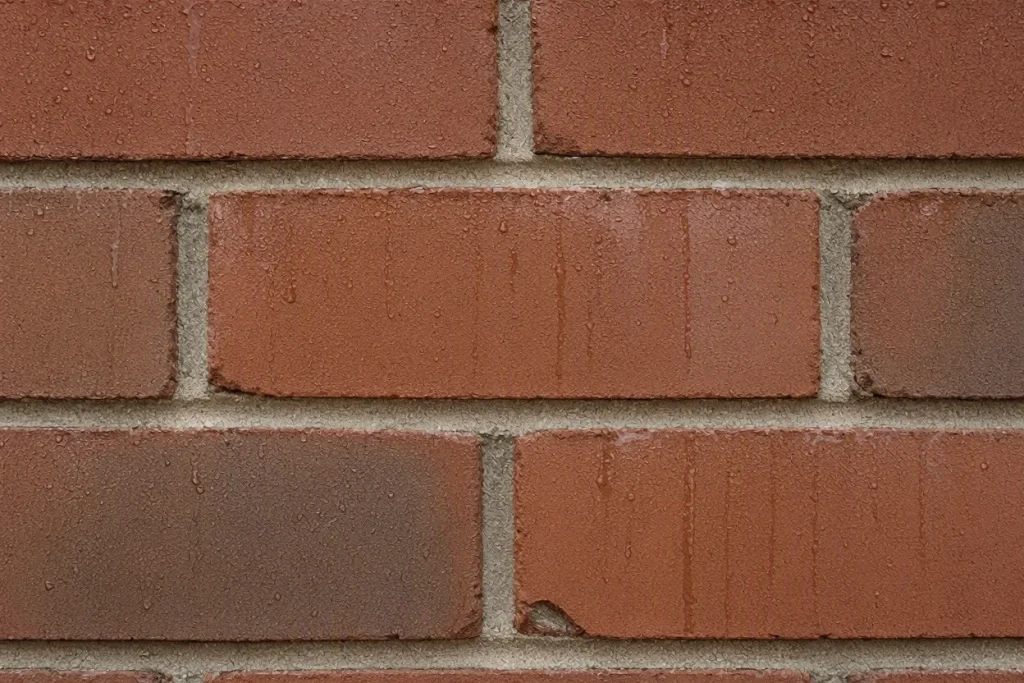
Graffiti on face brick is harder to clean than graffiti on a painted wall, because the paint soaks into the brick instead of sitting on top. So the real answer is to protect the wall before the next tag arrives. A clear, permanent coating such as Si-COAT 531AG Clear lets you wash new graffiti off with water. Because it is clear, the brick still shows through.
This article is for whoever looks after the walls. That might be a municipal property manager, a school bursar, a body corporate trustee or a shopping centre facilities manager. You chose face brick because it needs no paint. Then someone tags it, and you find out it is the hardest surface on the property to clean.
Why graffiti on face brick is so hard to clean
Clay brick is porous. Spray paint and marker ink run into the pores and into the mortar joints, so a wash only removes what sits on the surface. As a result, you often end up with a ghost of the tag that no amount of scrubbing will shift.
The usual fixes cause their own damage. Abrasive blasting and hard wire brushing take off the hard fired face of the brick. Brick industry cleaning guidance warns that this damage is permanent and lets more water into the wall. Strong acid cleaners can stain or discolour the brick, especially lighter colours. High pressure water on bare brick can erode soft brick and old mortar. In practice, many owners give up and paint over the tag with a colour that never quite matches.
Then the tag comes back, and the cycle starts again. We covered that recurring cost in our article on graffiti removal costs in Cape Town. Also see this graffiti removal guide on why a permanent coating beats repeated chemical cleaning.
How a clear coating protects face brick from graffiti
Si-COAT 531AG Clear is a one part, moisture cure RTV polysiloxane made by CSL Silicones. It bonds chemically to the brick and stays there. That means it is permanent, not sacrificial, so you do not recoat after every clean. The cured film is water repellent, so most graffiti lifts off with a cold water pressure wash.
Because it is clear, there is no colour to match. That matters for graffiti on face brick, since every brick differs slightly and no paint will ever blend in. The same goes for brick murals and branded walls. However, the finish is semi gloss, while most face brick is matte. As a result, the brick may look slightly darker as well as pick up some sheen. So always do a test patch first and let the owner look at it in daylight before you coat the whole wall.
For background on the product itself, see our anti graffiti coating guide.
Preparing and coating a face brick wall
First, remove existing graffiti as well as you can. A clear coat will lock in whatever is left underneath, so any ghosting stays visible for the life of the coating.
Next, clean the wall. The surface must be free of dirt, dust, mortar spatter, old caulking, grease and oil. Also remove release agents, curing compounds, laitance and loose white salt bloom. You do not need abrasive blasting. Also, most surfaces need no primer. Still, CSL recommends a quick field adhesion test, and the test patch covers that too.
Then let the wall dry. Brick holds water for a while after rain or washing, and the coating needs a clean, dry surface. Air and surface must sit between 5°C and 60°C and at least 3°C above dew point. On the coast, watch for early morning condensation, because moisture during or just after application can leave a matte, patchy finish.
Before use, mix the pail with a powered mixer at 300 to 400 rpm for at least 5 minutes. After that, apply about 0.15 to 0.25 mm once dry (6 to 10 mil, 152 to 254 µm). That works out to roughly 0.2 to 0.35 litres per m² before losses. Porous brick drinks more, so expect to use more than on smooth concrete. Airless spray gives the best finish and reaches into raked joints. By contrast, brush or roller suits small areas only and needs more than one coat.
At 25°C and 50% humidity, the coating skins in 20 to 30 minutes and is tack free in 60 to 90 minutes. Within 4 to 6 hours it is cured through, and full properties take 7 days. CSL supplies it for professional applicators only.
Removing graffiti from coated face brick
Speed helps. Wash new graffiti off as soon as possible with a cold water pressure washer at about 1,200 psi (roughly 83 bar). If a tag has sat for more than 10 days and resists cold water, switch to a warm water pressure wash. In rare cases, specialty paints with adhesion primers hang on. For those, use a biodegradable surfactant such as dish soap with a cleaning pad, then rinse straight away.
Still, brick needs some care. The water now hits the coating, but chipped bricks, edges and soft mortar take the force too. So start at a lower pressure and keep the nozzle moving, well back from the wall. Use a wide fan tip, never a zero degree or turbo nozzle. Then work up towards 1,200 psi only if the paint will not lift. Also test any cleaner on a small hidden patch first.
Our anti graffiti case studies page shows CSL projects on concrete walls, underpasses and stone masonry. For other products, see our main case studies page.
Where not to use Si-COAT 531AG Clear
- First, do not coat a wall where the owner cannot accept any change in look. Agree a test patch before you start.
- Second, do not coat over crumbling brick, loose mortar or flaking paint, because the coating only holds what is sound. Repair first.
- Also, do not use it to cure a damp problem. Fix rising damp, leaking gutters and failed copings first, then let the wall dry out. If white salt bloom comes back year after year, water is still getting in, so find the source before you coat.
- In addition, ask us first where severe chemical or solvent splash or pooling is likely, because CSL must confirm suitability.
- Finally, a structure older than 60 years needs a permit from the provincial heritage resources authority before you alter it. Under the National Heritage Resources Act, a change in appearance counts as altering.
However, steel gates and palisade fencing on the same boundary often need a different fix. If the steel is already rusting, treat the corrosion first with a maintenance coating such as Si-COAT 579 CM.
Graffiti on face brick: common questions
Will a clear coating change how the brick looks?
Slightly, because the finish is semi gloss. So a matte brick will pick up some sheen and may look a little darker. That is why we insist on a test patch before the full job.
Can old graffiti on face brick be coated over?
No. Remove it first, because a clear coat seals in whatever is underneath. Any ghost of the old tag will stay visible.
Does the coating protect the mortar joints?
Yes, if the applicator works it into the joints. Airless spray reaches raked joints best. On small areas, a brush can push it in.
How soon can the wall be pressure washed?
The coating reaches full properties after 7 days at 25°C and 50% humidity. So plan the first pressure wash after that.
Can our own maintenance team apply it?
CSL supplies it for professional applicators only. However, your team can handle the cleaning afterwards. More answers are on our anti graffiti coating FAQ.
Technical Solution Supplies distributes CSL Silicones products across Southern Africa, including the DRC and the Seychelles. To plan a test patch on your walls, contact TSS.
Proud exclusive distributor of CSL Silicones in Southern Africa.