Hopper Corrosion Coating at Durban Harbour
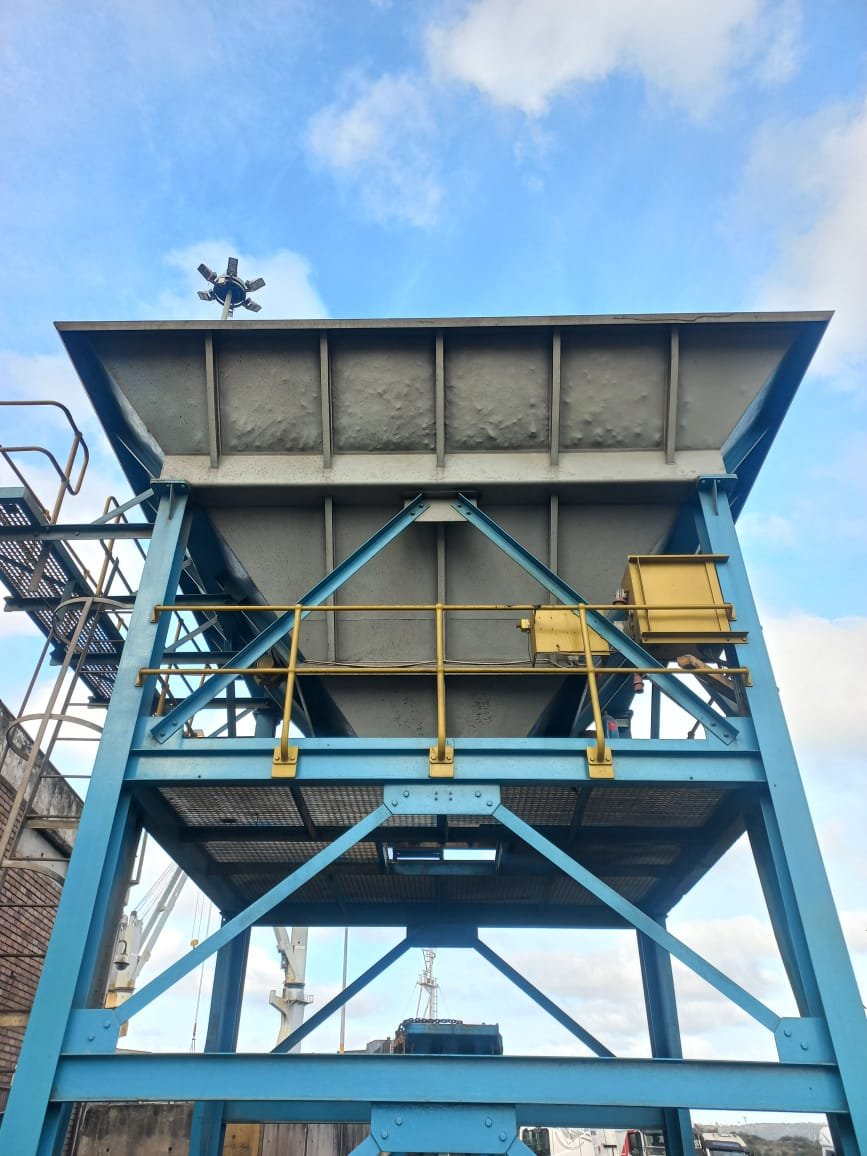
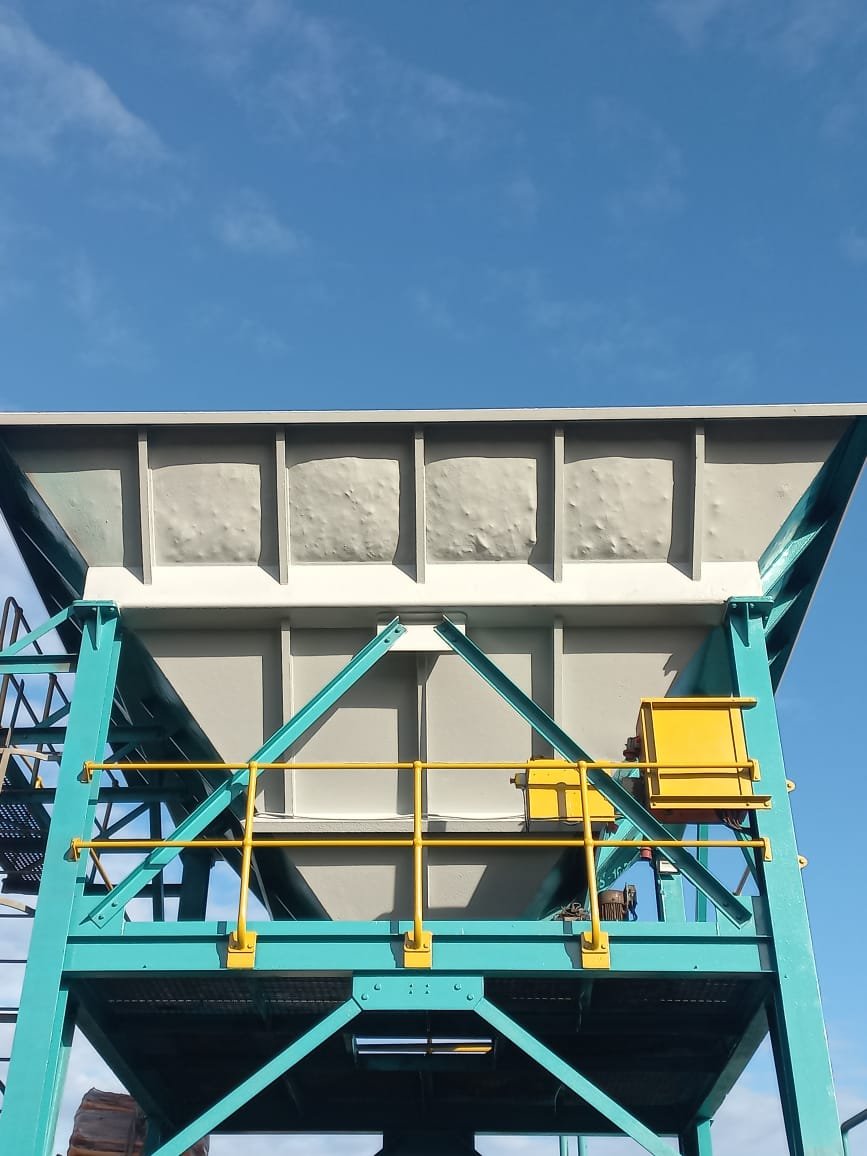
Hopper corrosion coating at a working port has to handle more than salt air. At Durban harbour, bulk loading inside a hopper cracked the epoxy on the outside, so in June 2024 the hopper got a new coat of Si-COAT 579 CM instead.
| Location | Durban harbour, KwaZulu-Natal, South Africa |
|---|---|
| Industry | Port and bulk materials handling |
| Exposure | Salt air, high humidity and constant impact from loading |
| Product | Si-COAT 579 CM, ANSI grey |
| Applied | 18 to 20 June 2024, no primer |
| Checked | 27 September 2024, and still in good condition today |
Download the full case study (PDF)
The problem: epoxy cracked under impact
The existing epoxy on the hopper could not solve the corrosion problem. It went on the outside as standard protection. However, every load of bulk material dropping into the hopper sent shock and vibration through the steel wall. Because epoxy is rigid and brittle, it can’t absorb that repeated loading, so the coating on the outside cracked.
Once epoxy cracks, things go downhill fast. Moisture gets through the cracks straight to the steel. In Durban harbour, with constant salt in the air and high humidity off the Indian Ocean, that starts rust quickly. In other words, the coating failed not from poor adhesion or bad application, but because its chemistry was wrong for the job.
The real issue is modulus. Epoxy cures to a stiff, high modulus film, so when the steel moves under impact, vibration or heat, the coating can’t follow. Silicone, by contrast, cures to a flexible elastomer that moves with the steel.
The repair: hopper corrosion coating with Si-COAT 579 CM
From 18 to 20 June 2024, the crew coated the hopper exterior with Si-COAT 579 CM in ANSI grey. First, they used hand and power tools to remove loose rust, cracked epoxy and dirt. They did not blast or prime. Then the single component, moisture cure silicone went straight onto the prepared steel.
As a result, the job needed no hot work, no blasting equipment and no long shutdown. Meanwhile, the port kept working normally throughout.
Three months on: hopper corrosion coating intact
At the three month inspection on 27 September 2024, the coating showed no cracking, blistering or corrosion. It had come through three months of daily bulk loading, the same impact that cracked the epoxy before.
That proved the main point. A flexible silicone coating takes the impact that cracks rigid epoxy, so the moisture barrier stays whole and rust can’t get started underneath.
Today: the hopper corrosion coating still holds
Since then, the hopper has stayed in service under the same loading. It is still in good condition today.
Why silicone beats epoxy as a hopper corrosion coating
On hoppers and other impact loaded steel, the difference between epoxy and silicone comes down to one property: elongation at break.
Epoxy cures to a rigid film with low elongation. So when impact runs through the steel wall, the film can’t stretch. Stress then builds up at surface irregularities, weld lines and edges, until cracks start and spread. In salty air like Durban harbour’s, those cracks let moisture straight in, and rust speeds up under the film.
Si-COAT 579 CM is a single component, moisture cure RTV silicone coating made by CSL Silicones. Its elongation at break is 180%. When impact runs through the steel, the film stretches and recovers instead of cracking. Without cracks, the moisture barrier stays whole, so rust has no way in.
The coating also stands up to the marine environment itself. It passed 3,000 hours of ASTM B117 salt fog testing. Similarly, it showed no degradation after 5,000 hours of UV weathering to ASTM G154. For the full results, see our silicone corrosion coating page, the Si-COAT 579 CM FAQ and the Florida Fence Test results.
Epoxy vs silicone hopper corrosion coating
Here is how the two compare on impact loaded steel in coastal air. The service life figure for 579 CM comes from the Florida power plant piping coated in 2003.
| Epoxy | Si-COAT 579 CM | |
|---|---|---|
| Film | Rigid, high modulus | Flexible elastomer |
| Elongation at break | Low | 180% |
| Under repeated impact | Cracks | Flexes and recovers |
| UV | Chalks without a topcoat | No degradation after 5,000 hours ASTM G154 |
| Salt fog | Varies by system | 3,000 hours ASTM B117, pass |
| Surface preparation | Abrasive blasting for most systems | Hand or power tool cleaning |
| Primer | Yes | No |
| Application | Multi coat system | One coat, no primer |
| Service life | Cracked early on this hopper | About 20 years, based on Florida piping coated in 2003 |
Key takeaways
Rigid coatings fail on impact loaded steel not from poor adhesion, but because they can’t handle the movement. So if you pick a coating for corrosion resistance alone and ignore the loading, failure is predictable.
Moreover, silicone’s flexibility is not a side benefit here. On hoppers, chutes and any steel under constant impact or vibration, it is the main reason the coating lasts.
Finally, one coat with no blasting, no primer and no hot work gives both the flexibility and the marine corrosion resistance a port needs. See how the same coating did on a crude oil tank in Athens, on concrete mixer trucks and at a chlorine plant.
Frequently asked questions
Why does epoxy crack on the outside of a hopper?
Bulk material hitting the inside of a hopper sends shock and vibration through the steel wall. Epoxy is a rigid, high modulus film, so it can’t flex with that movement. Instead, stress builds up at weld lines and surface irregularities, and cracks start and run through the film on the outside. Once it cracks, the coating stops keeping moisture out, and rust starts on the exposed steel.
What makes silicone the better hopper corrosion coating?
Silicone cures to a flexible elastomer rather than a rigid film. So when impact runs through the steel wall, the silicone stretches and recovers without cracking, and the moisture barrier stays whole. Si-COAT 579 CM has 180% elongation at break, far more than rigid epoxy systems, which suits hoppers and other bulk handling steel.
Does Si-COAT 579 CM need blasting on a hopper?
No. Hand or power tool cleaning (SSPC SP2 or SP3) to remove loose rust, cracked coating and dirt is enough. Edges, welds and bolts get a stripe coat first, followed by one full coat of 0.2 to 0.5 mm dry (200 to 500 microns, 8 to 20 mil). Without blasting, there is no blast containment to set up at a working port, and the operation keeps running. Our guide to steel surface preparation explains the grades in more detail.
How does 579 CM handle Durban’s coastal air?
It passed 3,000 hours of ASTM B117 salt fog testing. It also showed no degradation after 5,000 hours of UV weathering to ASTM G154, with a colour change below 1 delta E. Together, those results suit the salt, humidity and strong sun of a KwaZulu-Natal port, where epoxy and polyurethane systems wear out faster.
Can 579 CM go over cracked epoxy?
Only once the cracked, loose or poorly bonded epoxy is off. You remove it with hand or power tools, but sound, firmly bonded coating can stay. To check, the old coating must pass an ASTM D3359 tape test at 4A or 4B. After that, 579 CM goes straight over it.
Where can I get Si-COAT 579 CM?
Technical Solution Supplies distributes CSL Silicones products across Southern Africa, including the DRC and the Seychelles. For pricing, technical data and application support on port, mining and bulk handling steel, request a quote.
More corrosion protection articles
- Corrosion Coating Cost: How to Compare Quotes on Total Cost of Ownership

- Corrosion Protection in South Africa: Comparing the Methods That Actually Work

- Corrosion Protection Coating South Africa: Everything You Need to Know
- Corrosion Resistant Coating for Mining: Protecting Copper Operations Across Southern Africa
- Mining Corrosion Protection in South Africa: Why SI-COAT 579 CM Outperforms Traditional Coatings

- Anti-Corrosion Coating for Structural Steel: Why Silicone Outperforms Epoxy



Send us the problem
Photos and a rough size are enough to start, while drawings and specs can follow later. Then we come back with the right product and a quote.